Likely to sell out
2 hours·English, French
4.7(204)
Trou-aux-Biches: Submarine Tour to the Star Hope Wreck
Free cancellation40-minute dive in a submarine at 35 metersCertificate for diving in a submarine
See Mauritius underwater life without a wetsuit or a dive certificate. Descend 35 meters in a real submarine, stay completely dry in an air-conditioned cabin, and watch sea turtles, schools of surgeonfish and the Star Hope shipwreck glide past your window. Book the Trou-aux-Biches dive and meet the ocean floor today.
"A one-of-a-kind experience with a great team. We had an unforgettable time and would definitely recommend it!"
Ten properties worldwide let you sleep below the waterline, and none of them is here. What this island has instead is a real submarine that descends 35 metres to a shipwreck, and this guide gets you into its cabin.
No underwater hotel or restaurant exists in Mauritius; overwater suites and waterfront dining are what those searches actually return.
Mauritius is not sinking; the famous underwater waterfall off Le Morne is an illusion of shifting sand, visible only from the air.
The real dive goes to 35 metres in a dry, pressurized cabin for 40 minutes, with babies welcome from 9 months old.
Boarding requires climbing down a vertical ladder unaided in flat, grippy shoes; severe claustrophobia and heart problems rule it out.
Transfers are not included on the standard tour, so from Flic-en-Flac or the south plan roughly an hour to ninety minutes by taxi.
Book your dive for early in your stay so a rough-sea day leaves room to reschedule, and if the operator cancels before departure you can rebook another day or take a full refund.
The pictures are seductive: a bed beside a tank of sharks, dinner below the waves. The reality on this island is simpler. Mauritius has no true underwater restaurant and no underwater hotel room. What the searches return are overwater suites standing on stilts above a lagoon, and waterfront dining venues at the surface.
Globally, ten properties offered rooms below the waterline as of October 2026. Not one sits in Mauritius. If sleeping beneath the waves is non-negotiable, the nearest options are on other continents.
What the island does offer is a way under the water that those suites only imitate: a passenger submarine that dives to 35 metres off Trou-aux-Biches. For the reader chasing the underwater dream, that descent is the closest bookable thing on the island.
It is not. The island sits on stable oceanic crust with no active volcano and earthquake hazard rated very low.
It is shifting sand and silt sliding down an ocean trench off Le Morne, an optical illusion seen from the air.
Heavy swells over the reef there produce fatal outflowing rip currents. Stay out of that channel.
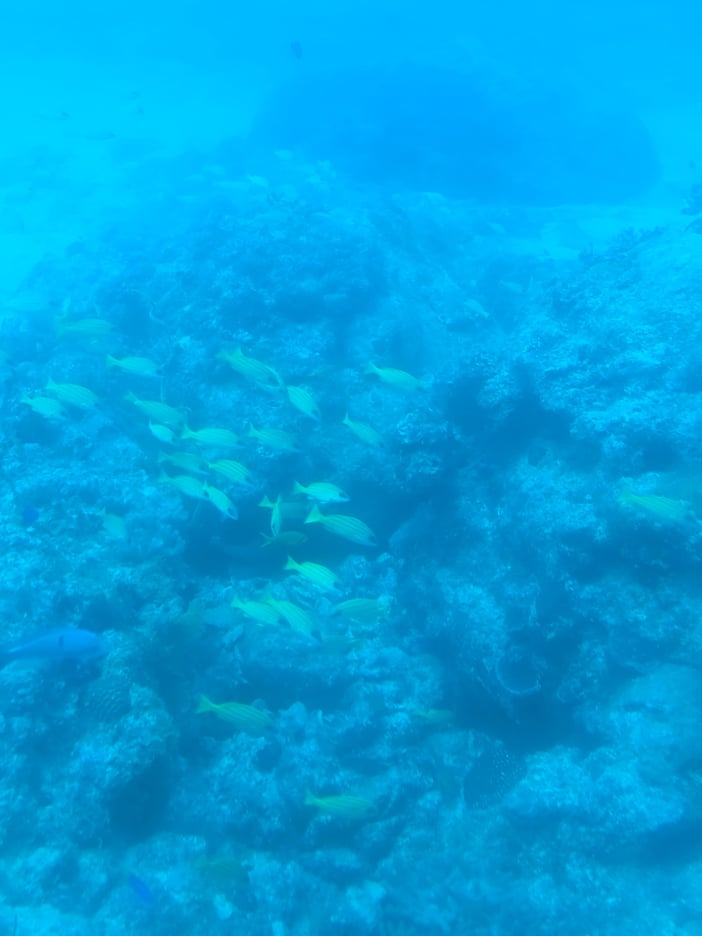
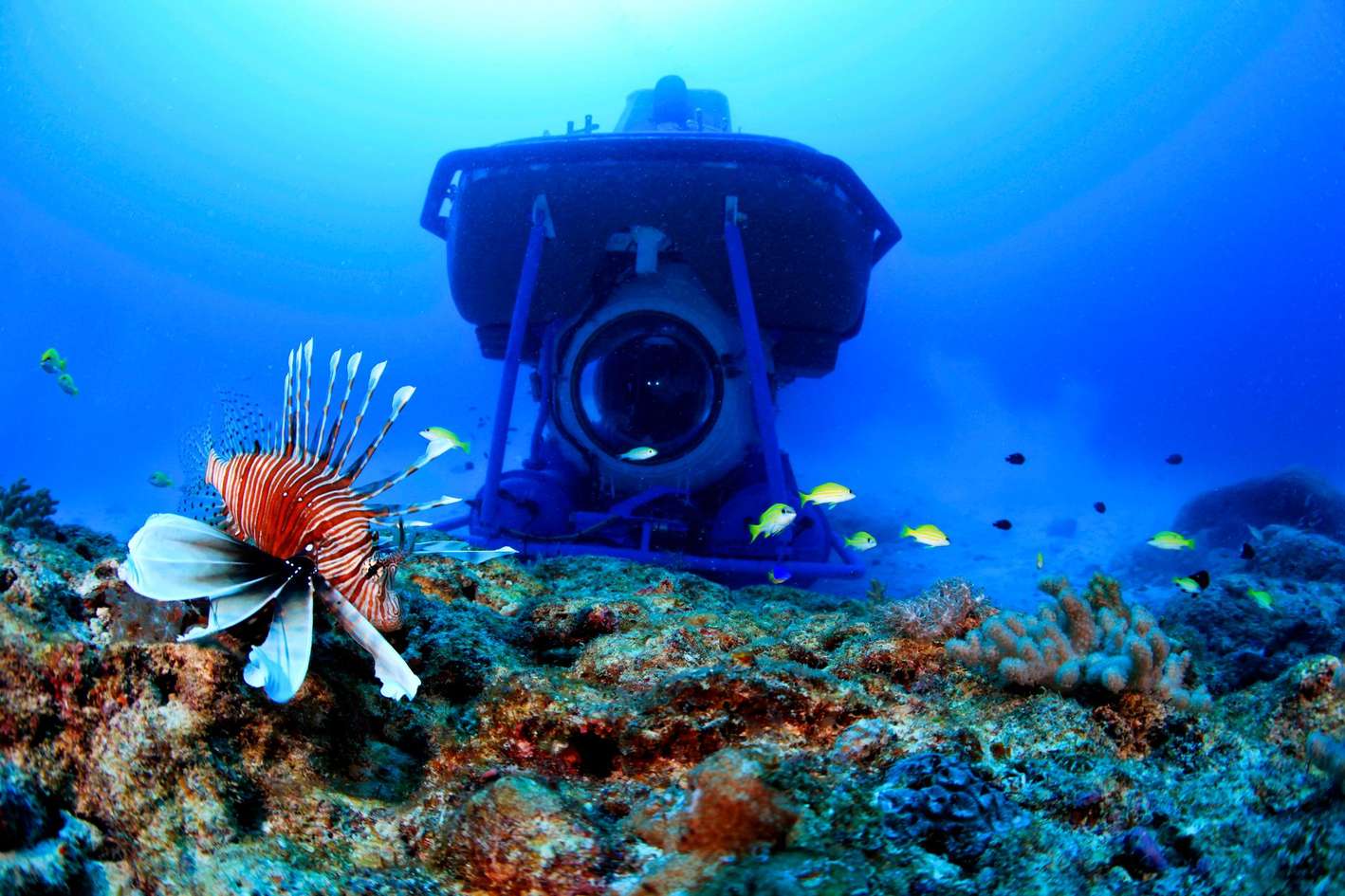
Set expectations before you set foot on a boat. More than 100 fish species live in these waters, and butterflyfish, surgeonfish, parrotfish, clownfish and jackfish appear in good numbers all year.
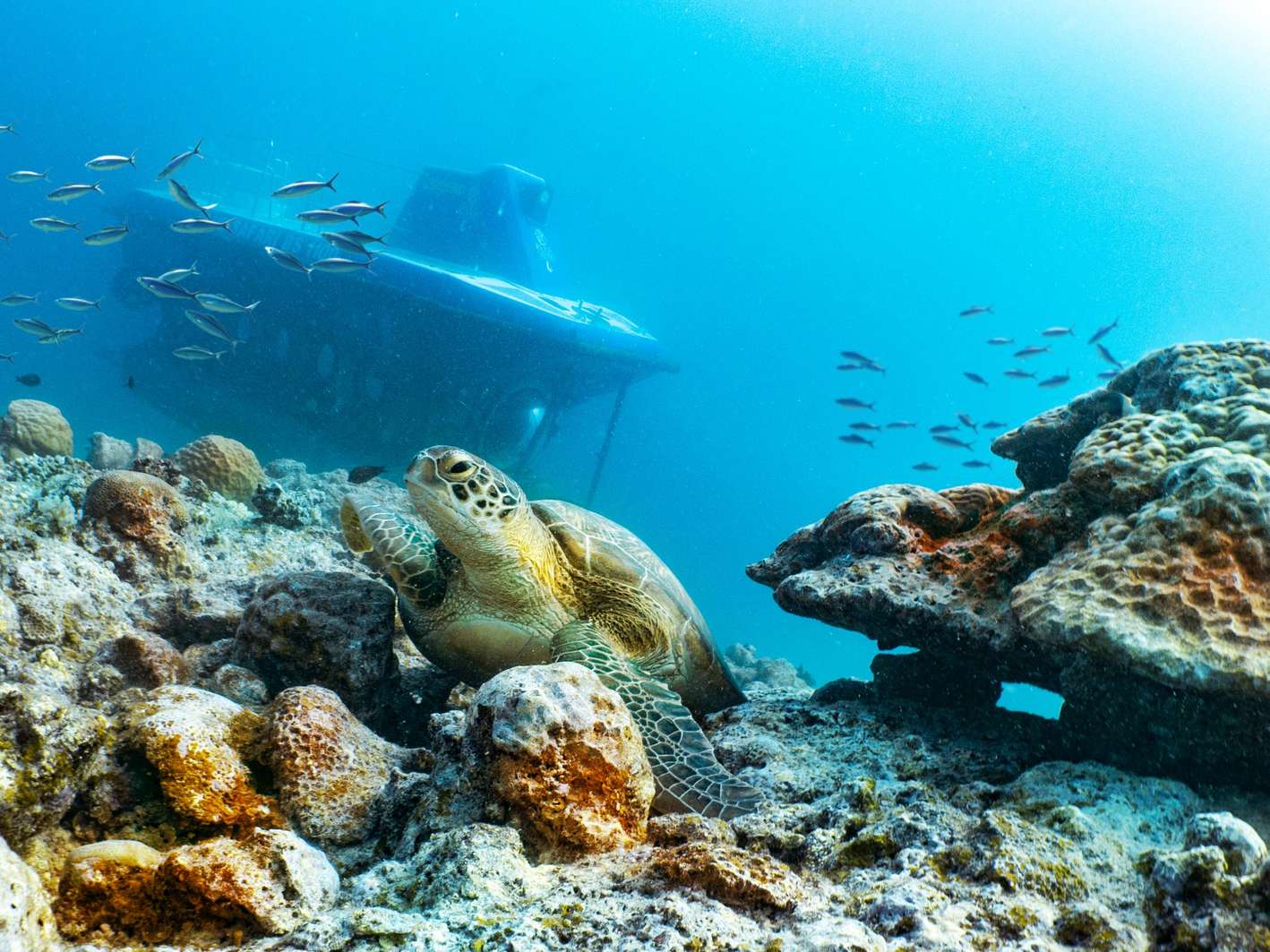
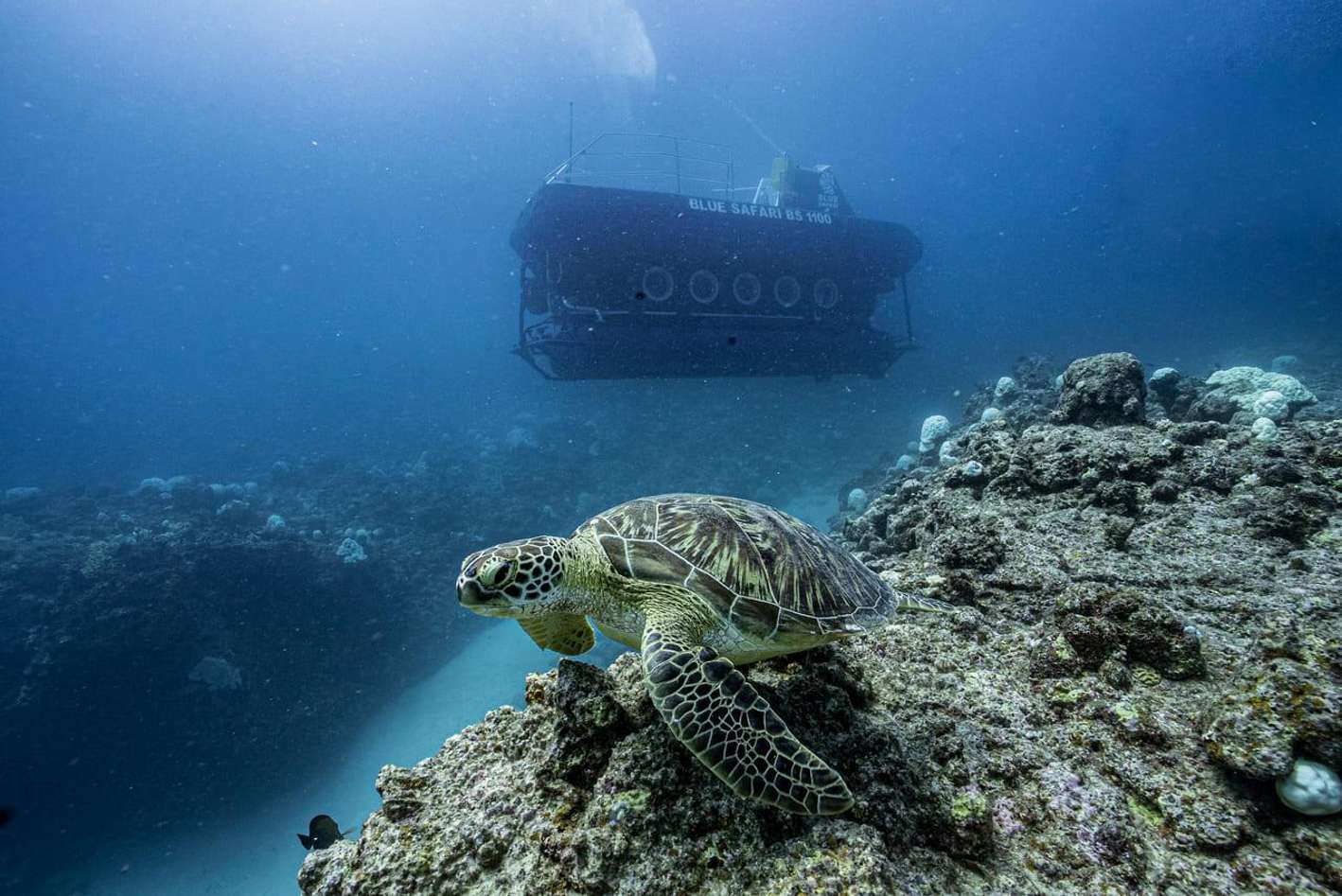
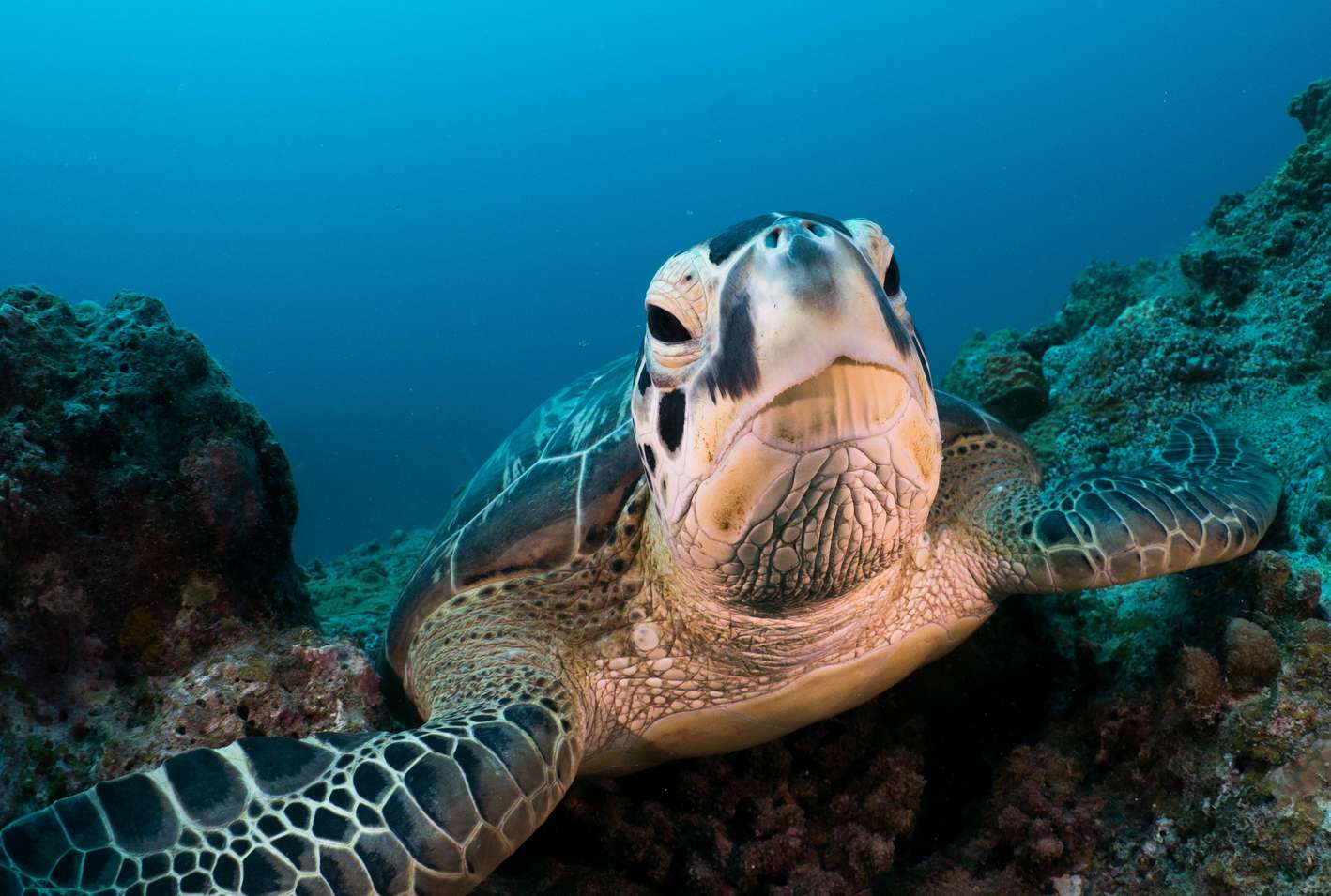
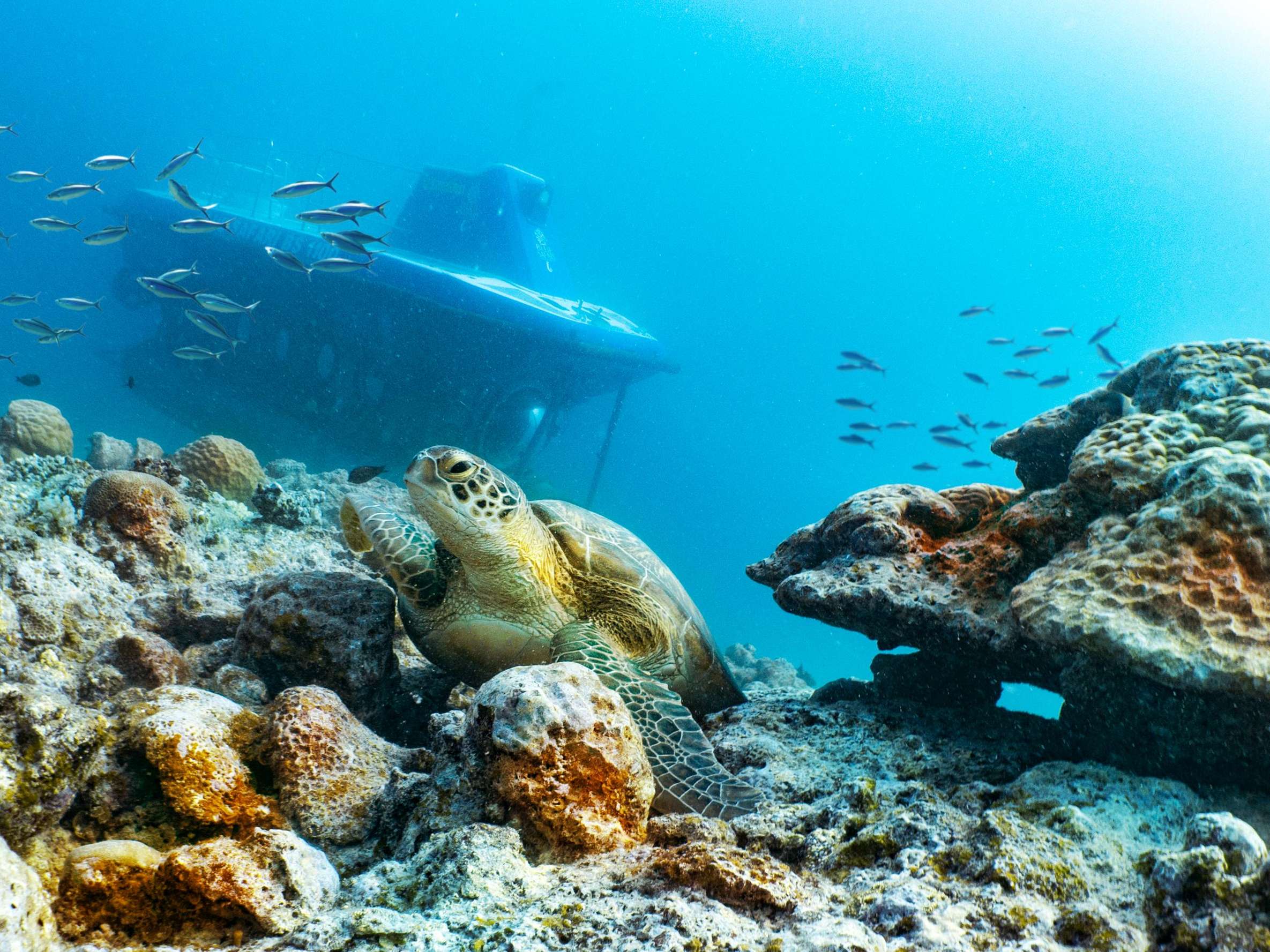
Green and hawksbill turtles graze the lagoons and reef slopes throughout the year, with sightings peaking between December and April. Stingrays show up almost every month. Reef sharks appear only occasionally, and in small numbers.
Now the honest part: the near-shore reefs outside many hotels have seen better days, and a first snorkel off the sand can feel thin compared with the Red Sea.
The density lives around structure. Resort stone breakwaters often hold pockets of reef fish right off the beach, and sunken wrecks and artificial reefs carry far more life than bare sand.
That is why depth matters on this island. The Star Hope wreck at 35 metres, with moray eels and turtles around it, sits exactly where the fish concentrate, and only a submarine reaches it.
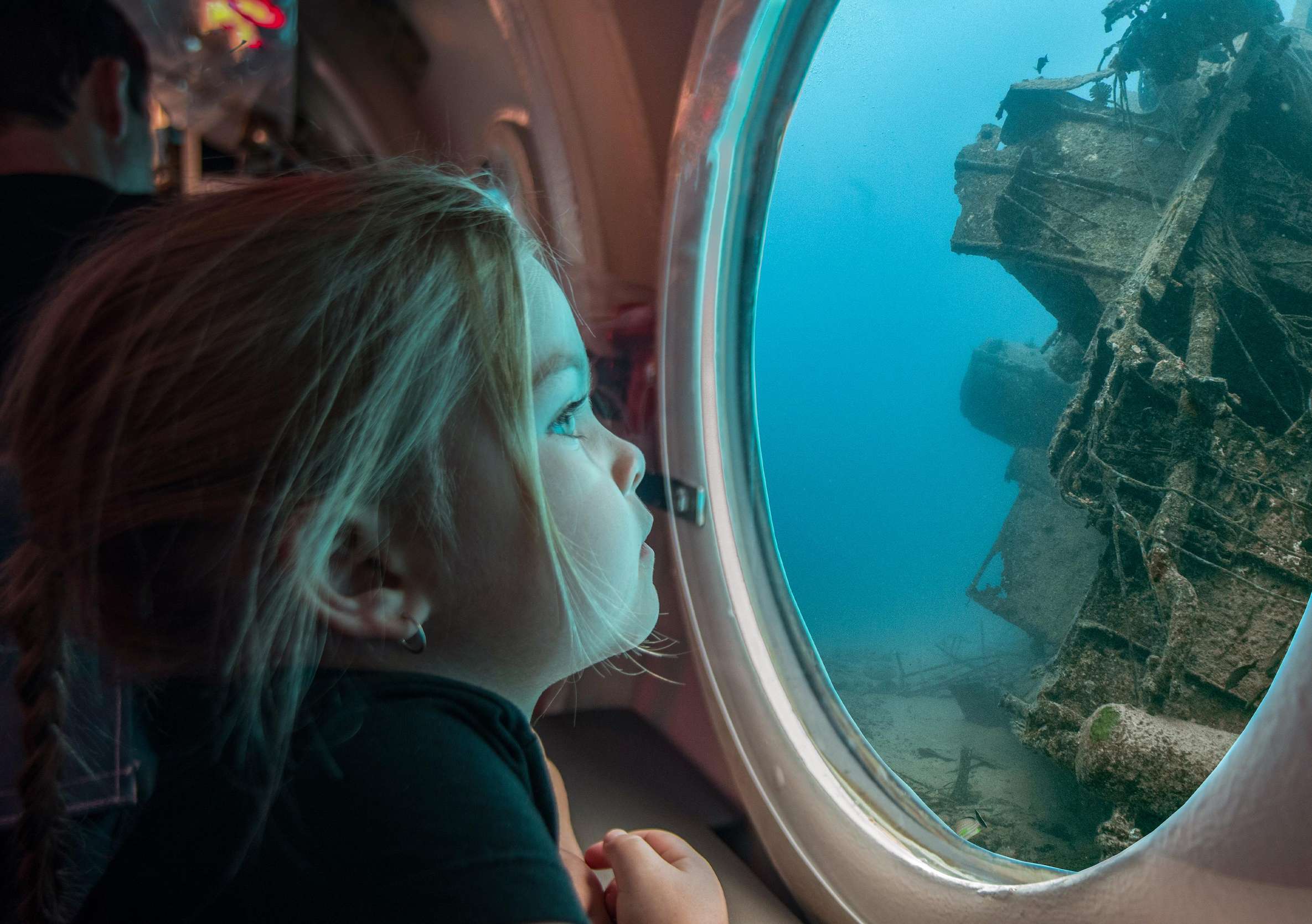
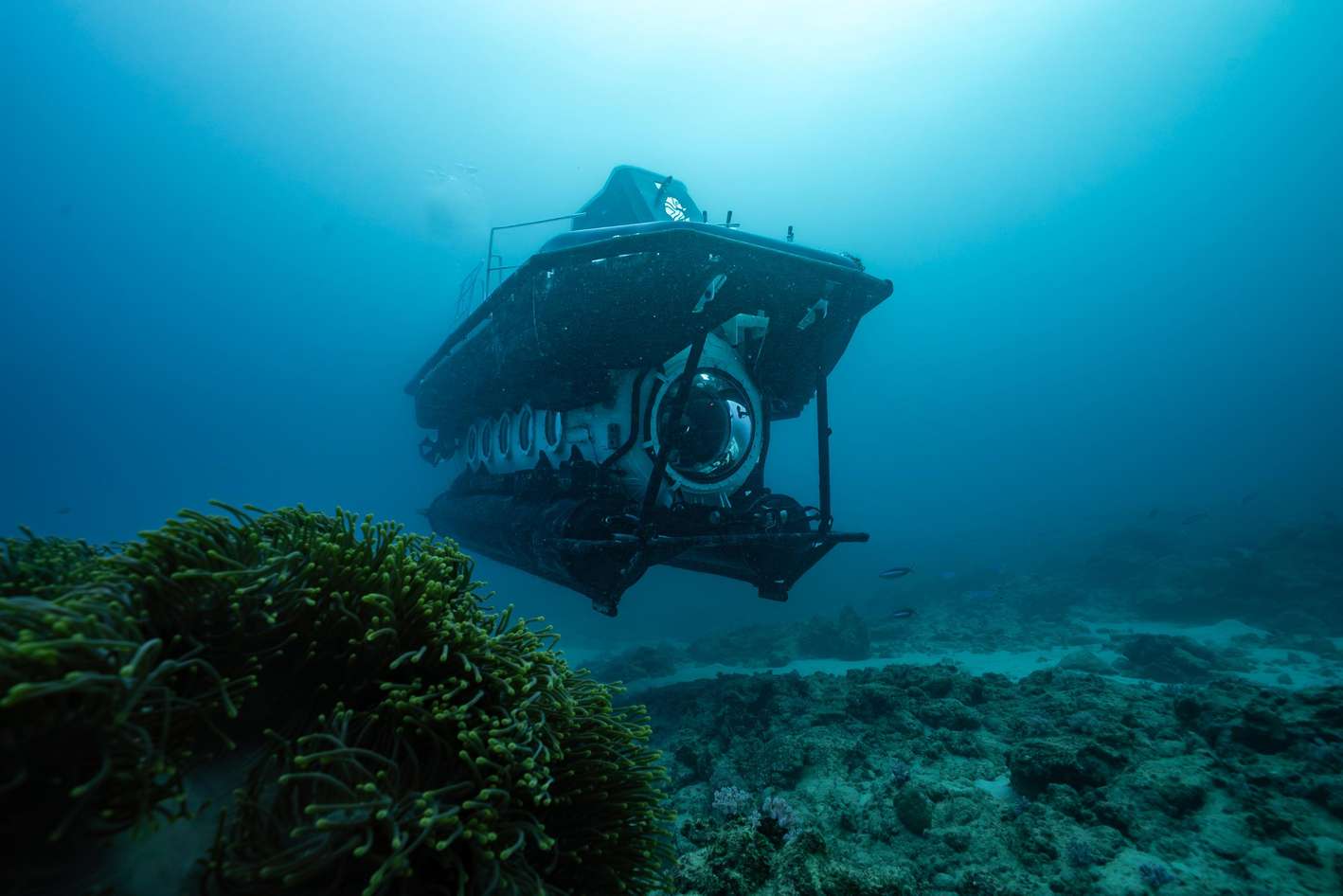
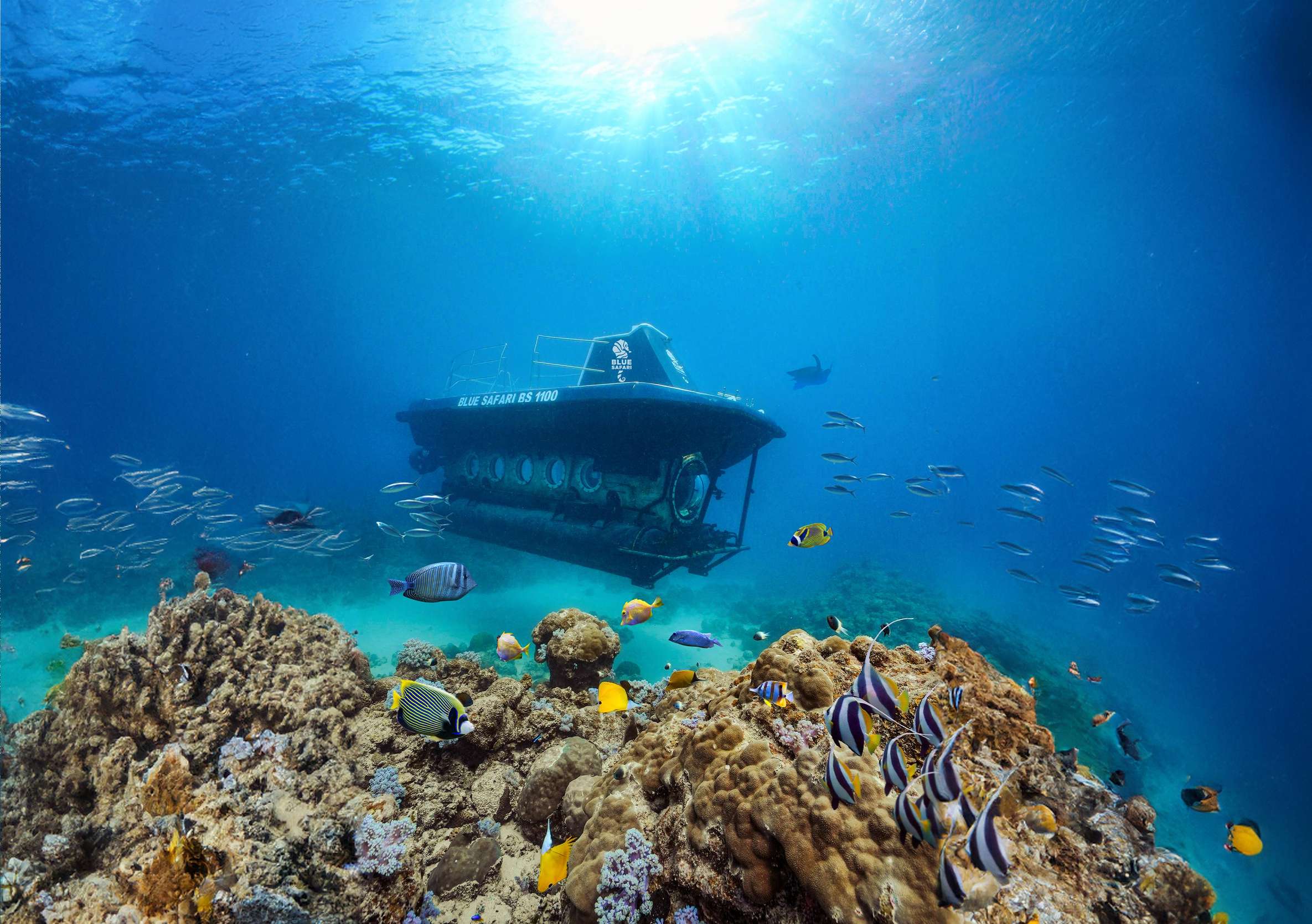
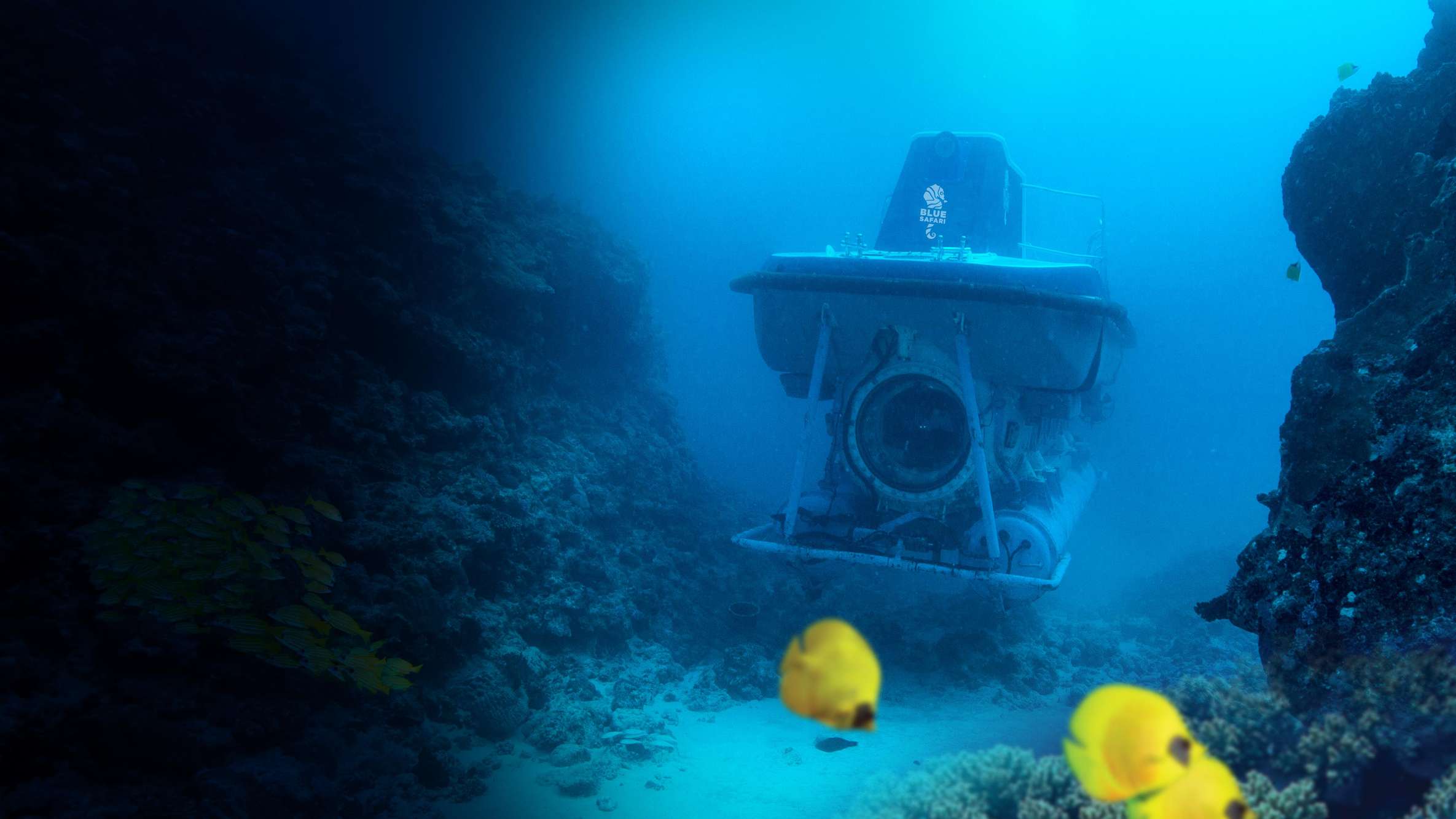
Three ways to see this island's ocean life, three very different depths. A true submarine is a sealed pressure vessel that dives 35 metres down in a dry, air-conditioned cabin, with no ear pressure changes and no decompression risk.
A semi-submarine never dives; its cabin sits 1.5 metres below the surface, with an open upper deck you can climb to whenever you like. A glass-bottom boat stays on top and looks down through a hull panel.
Then there is the dry-land option. The Odysseo Oceanarium in Port Louis keeps you behind glass tanks and acrylic tunnels, fully accessible and any age, with the open sea on the far side of the glass.
| Exists in Mauritius | Marine life seen | Viewing depth | Age and access | Location | |
|---|---|---|---|---|---|
| Submarine dive | Yes, real diving submarine | Turtles, morays, 100+ fish | 35 m, dry pressurized cabin | From 9 months; ladder climb needed | Blue Safari, Trou-aux-Biches |
| Semi-submarine trips | Yes, surface vessels | Reef views through side windows | Cabin 1.5 m below surface | Any age; walk-down steps | Boats leave Trou-aux-Biches |
| Odysseo Oceanarium | Yes, indoor aquarium | 200 species: sharks, rays, jellyfish | Glass tanks, not open sea | All ages, wheelchair friendly | Harbour Waterfront, Port Louis |
| Underwater dining | None; surface venues only | not known | not known | not known | not known |
| Underwater hotels | None; overwater suites only | not known | not known | not known | not known |
One line of that table settles the choice for most readers. The submarine is the only option that puts open ocean around you and the only one that reaches a wreck; the semi-submarine and the aquarium trade depth for ease.
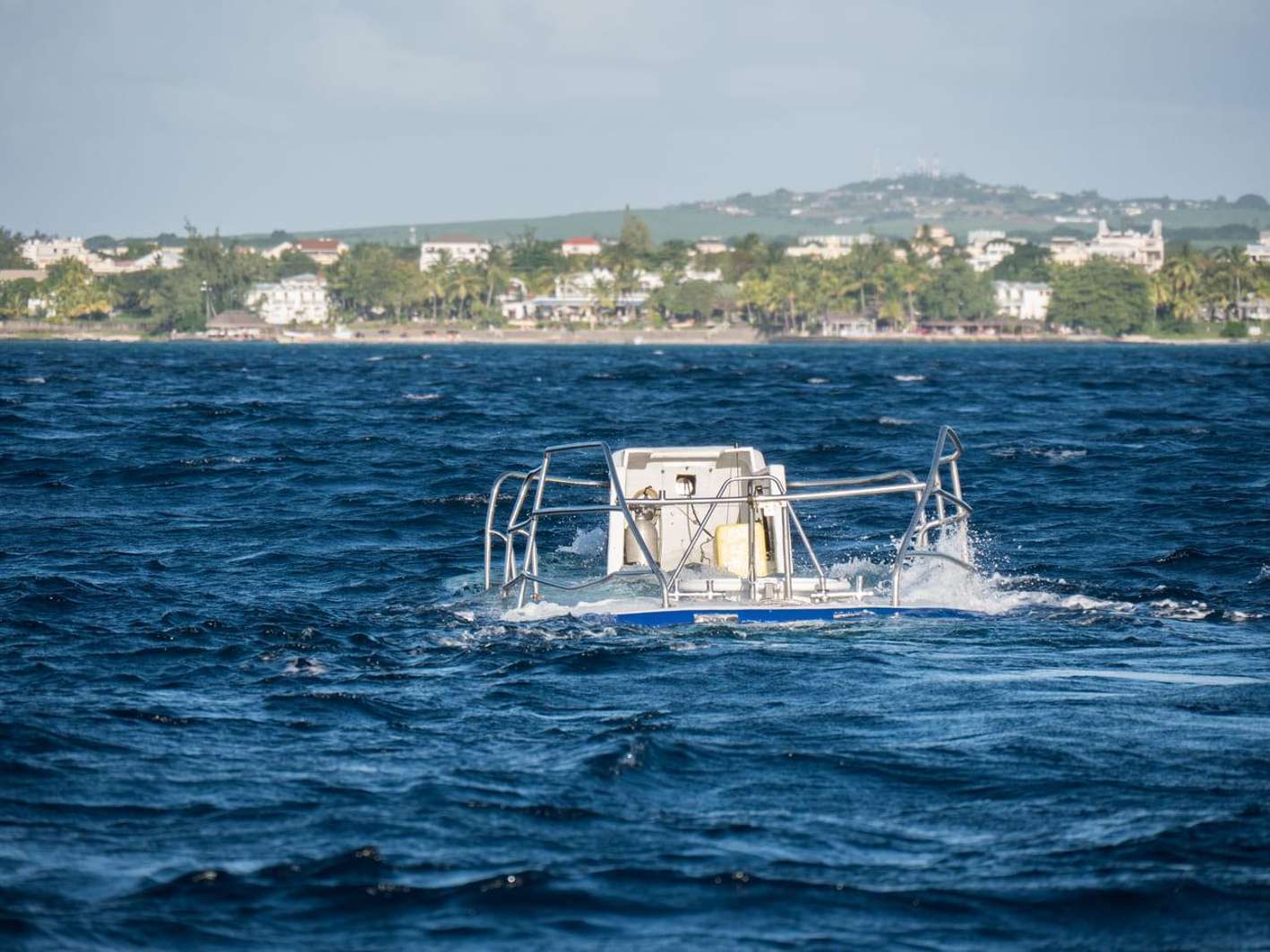
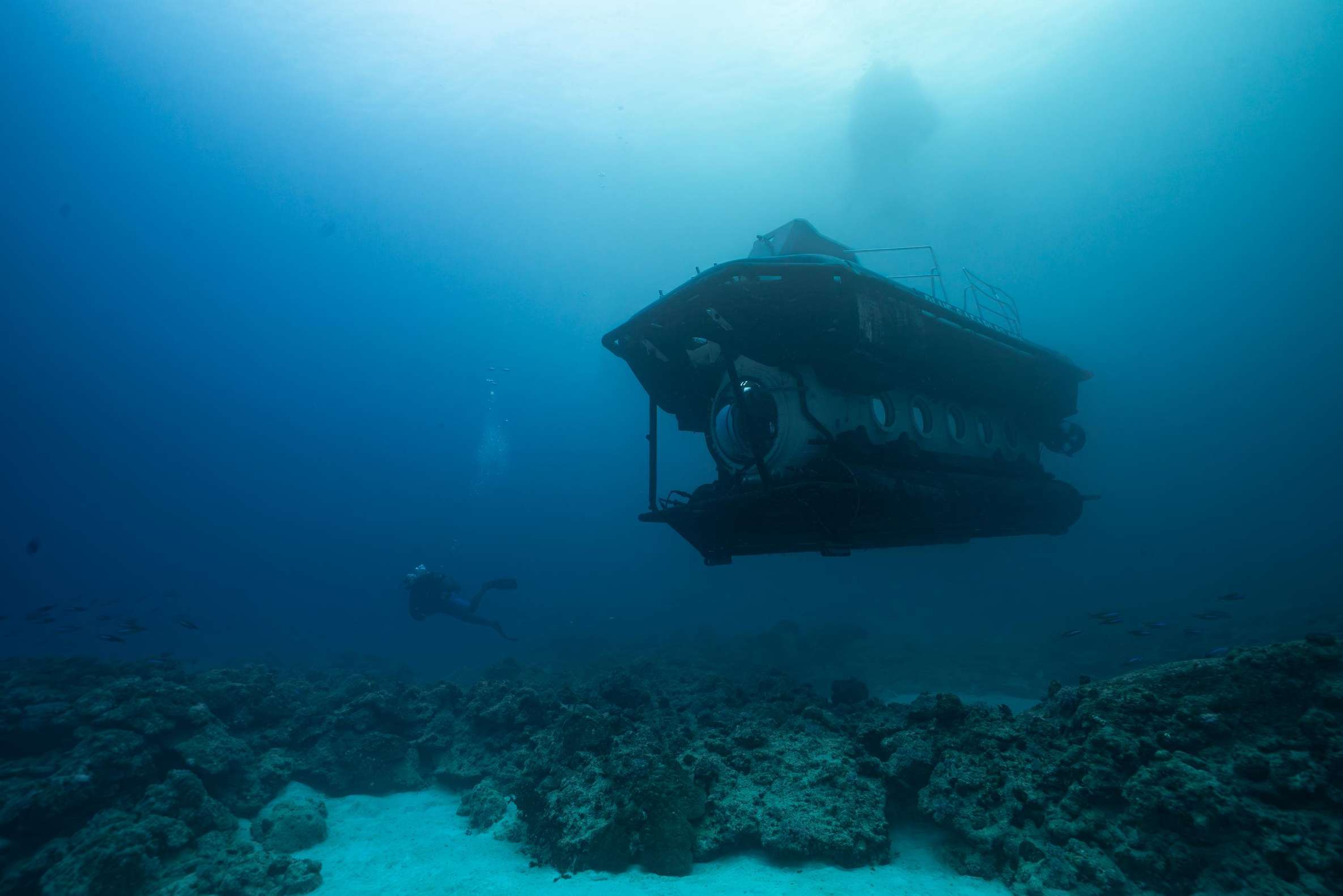
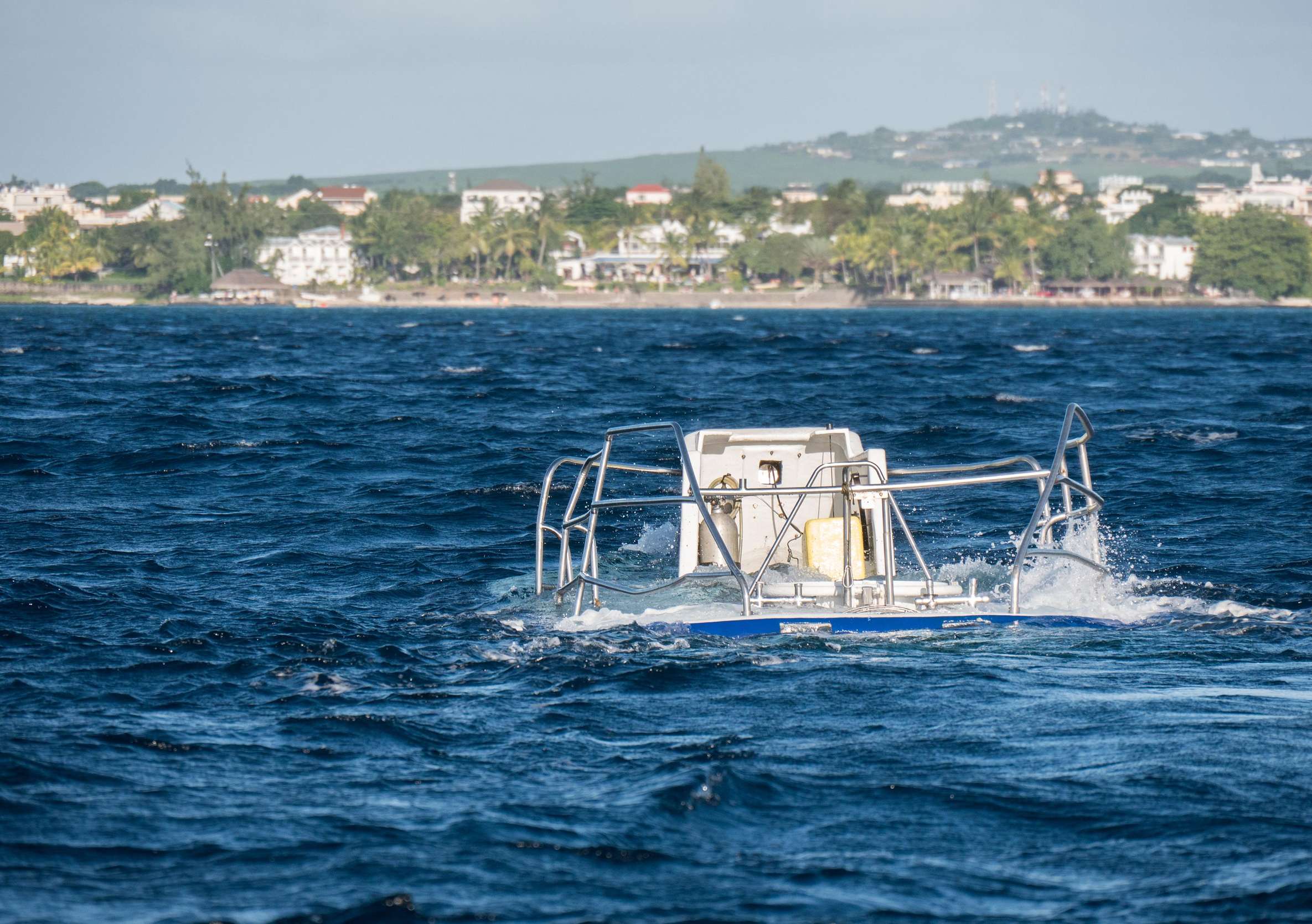
The morning starts on Coastal Road in Trou-aux-Biches, at the check-in desk that shares its site with the restaurant Le Pescatore. Staff greet you with a welcome drink and a briefing, then a shuttle boat carries you out to the offshore platform where the submarine sits bobbing on the swell.
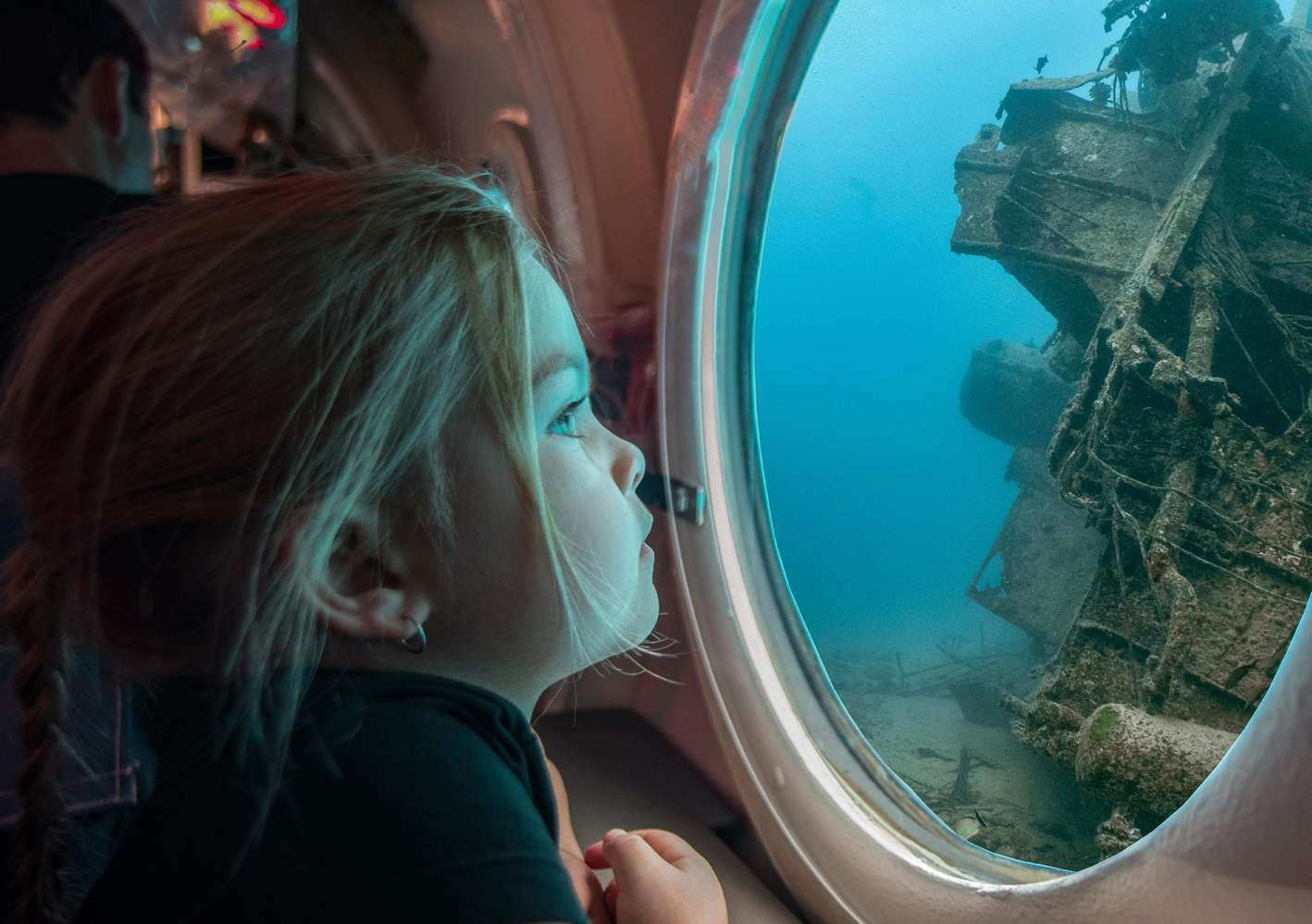
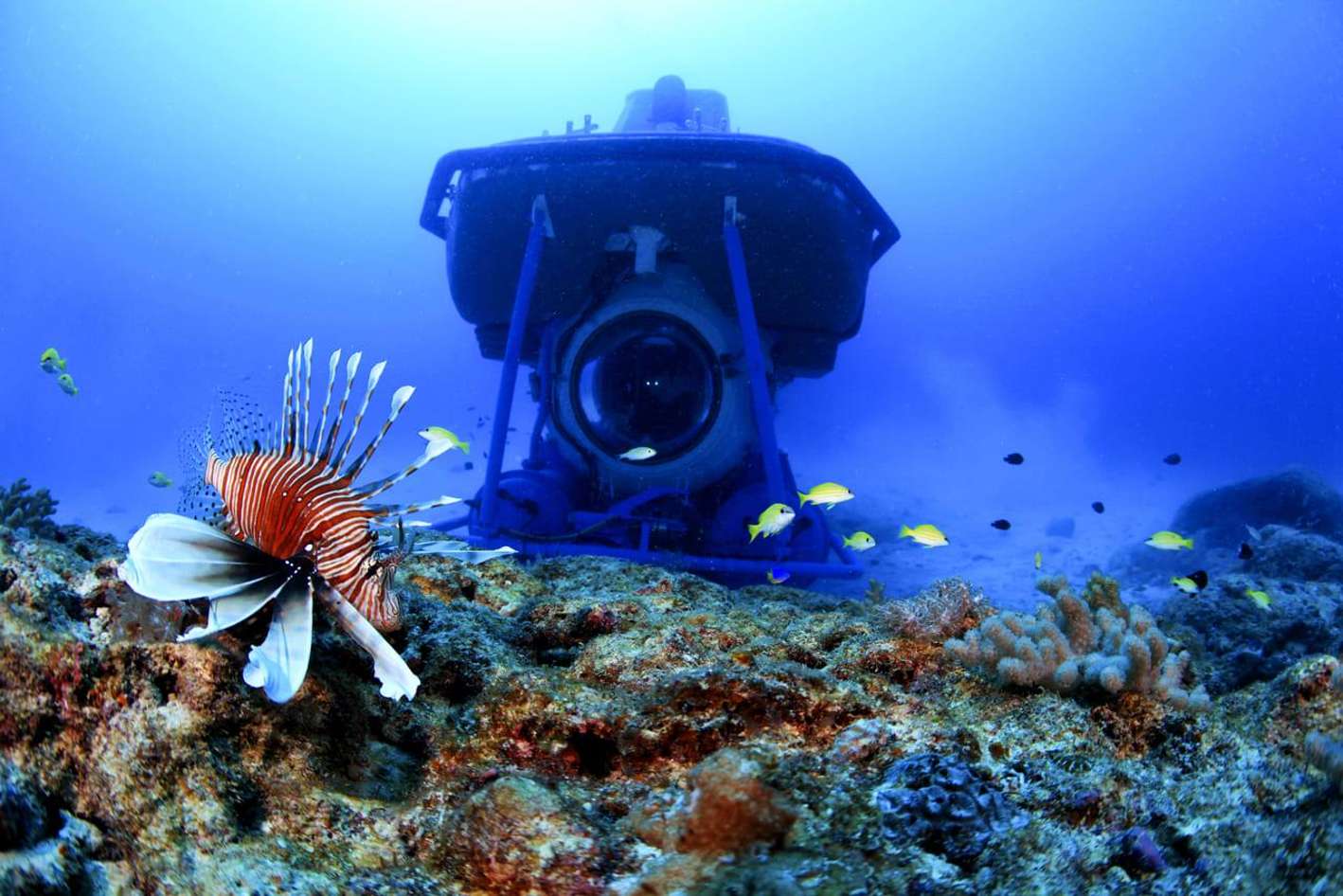
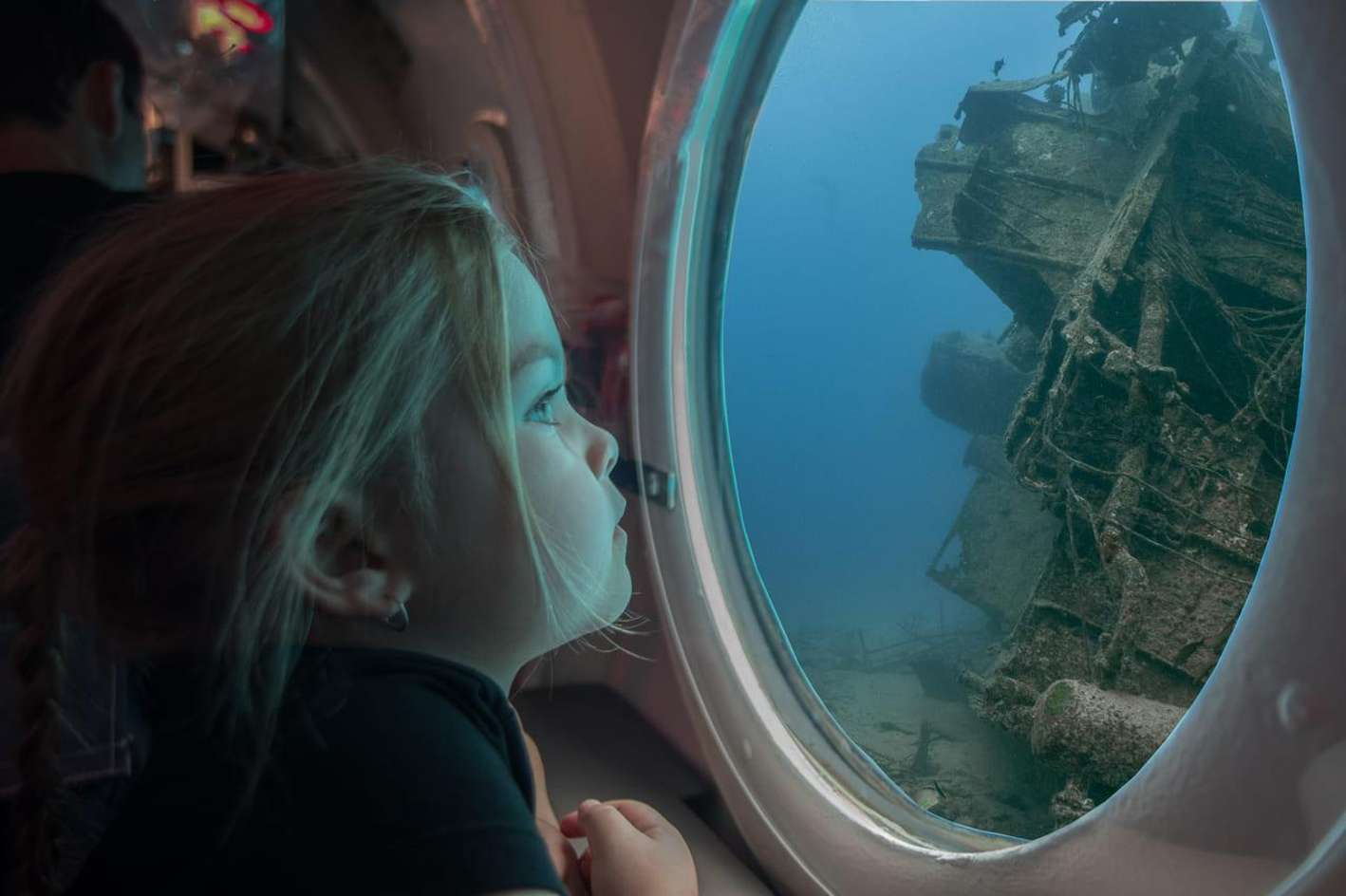
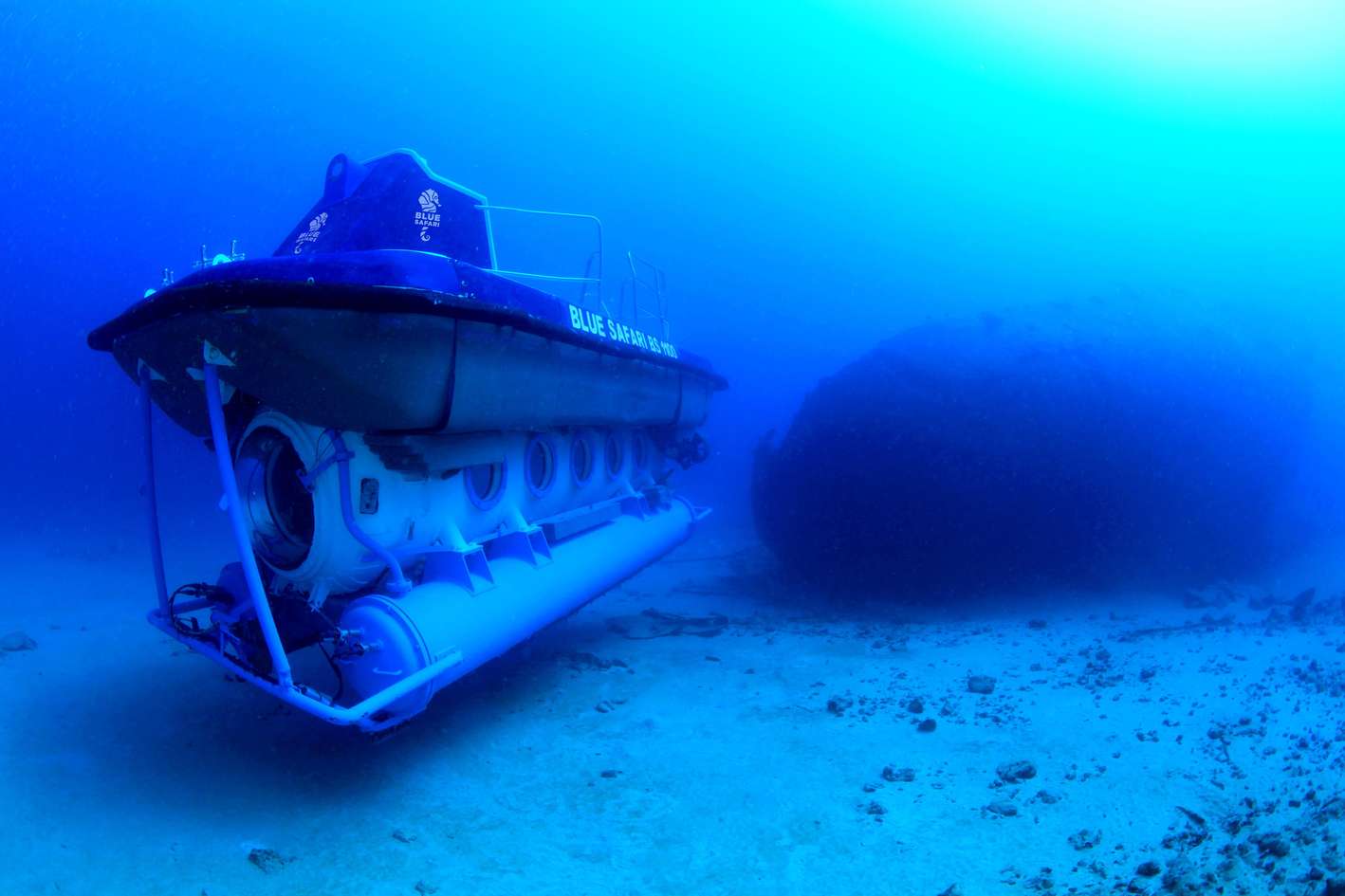
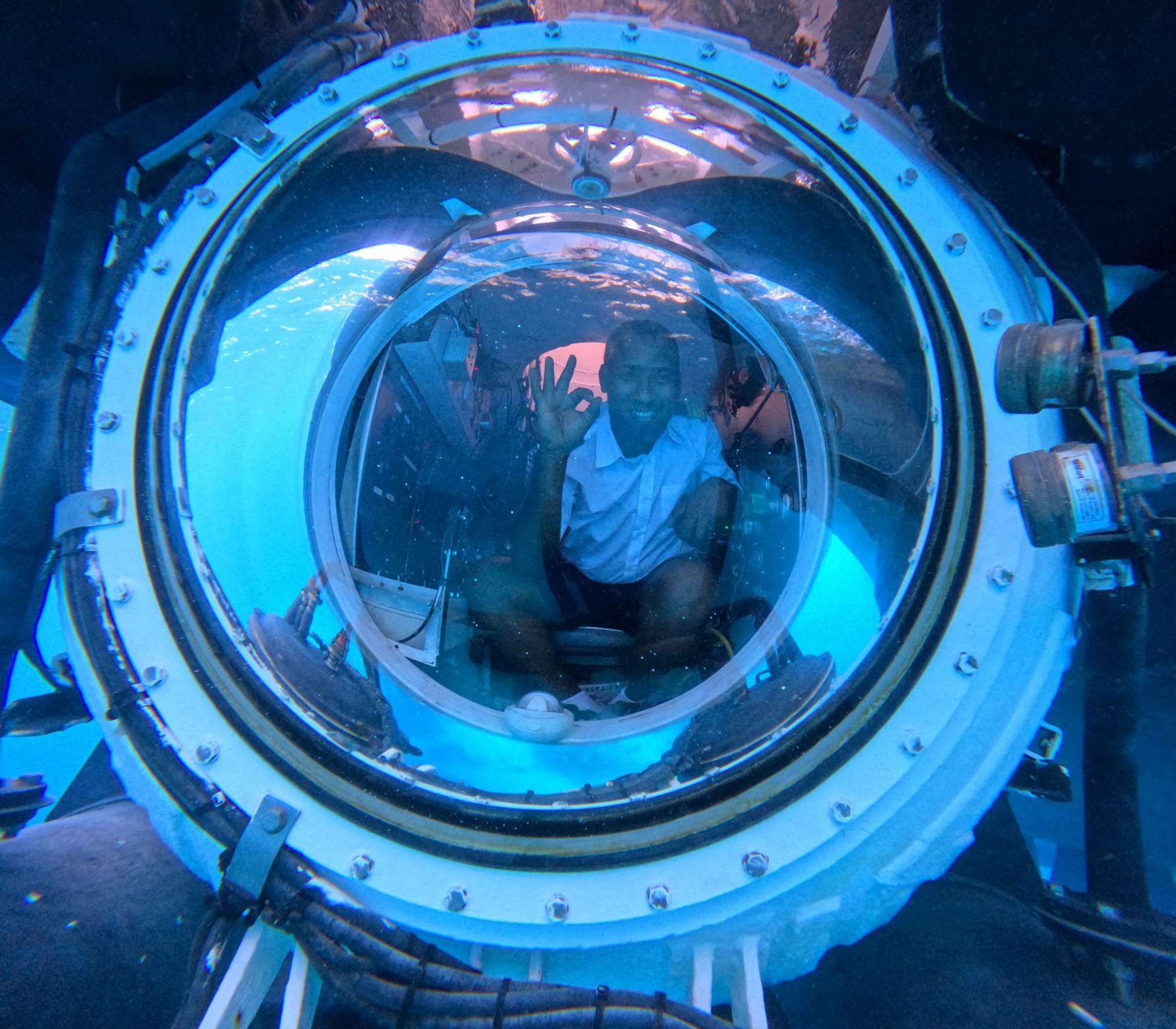
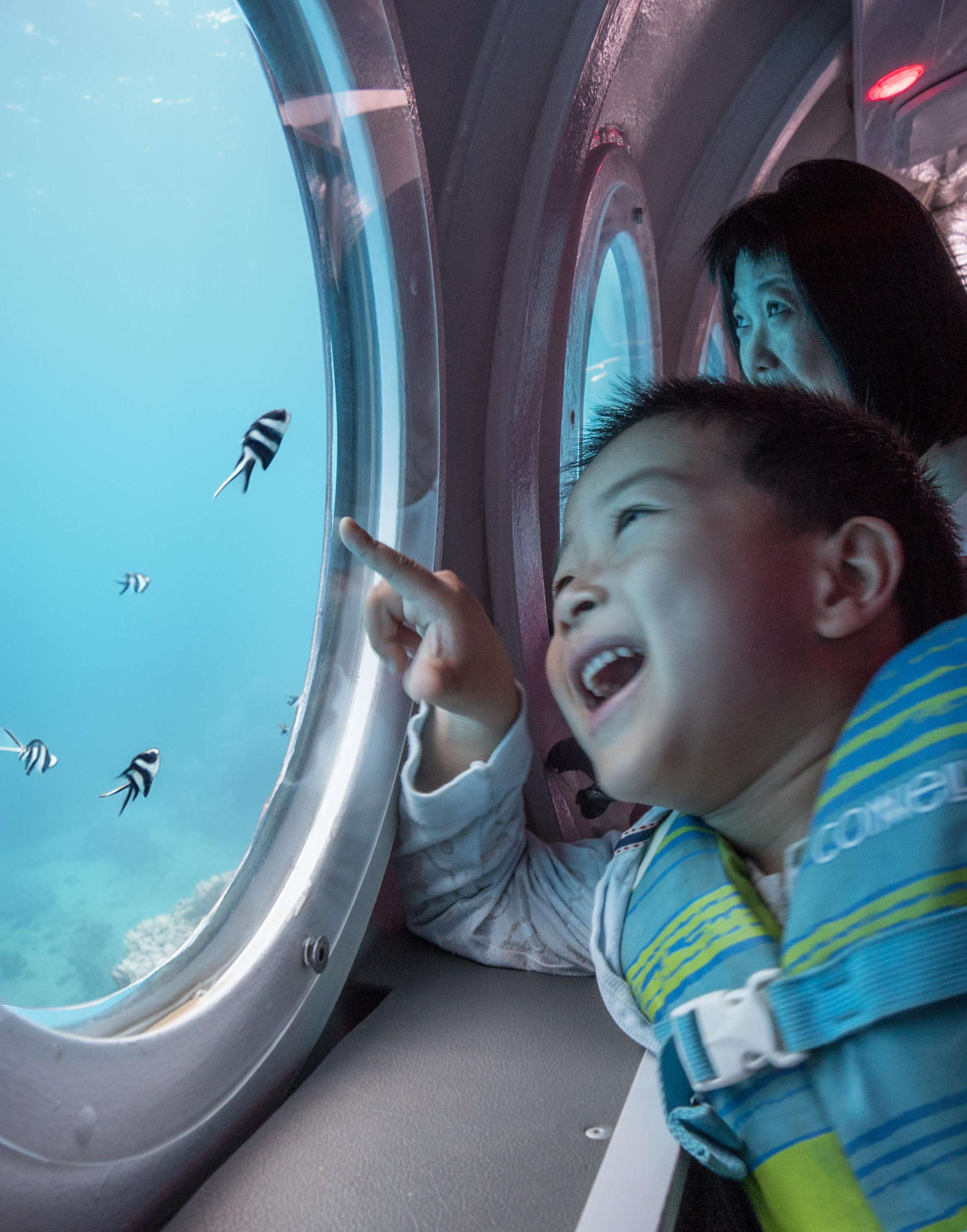
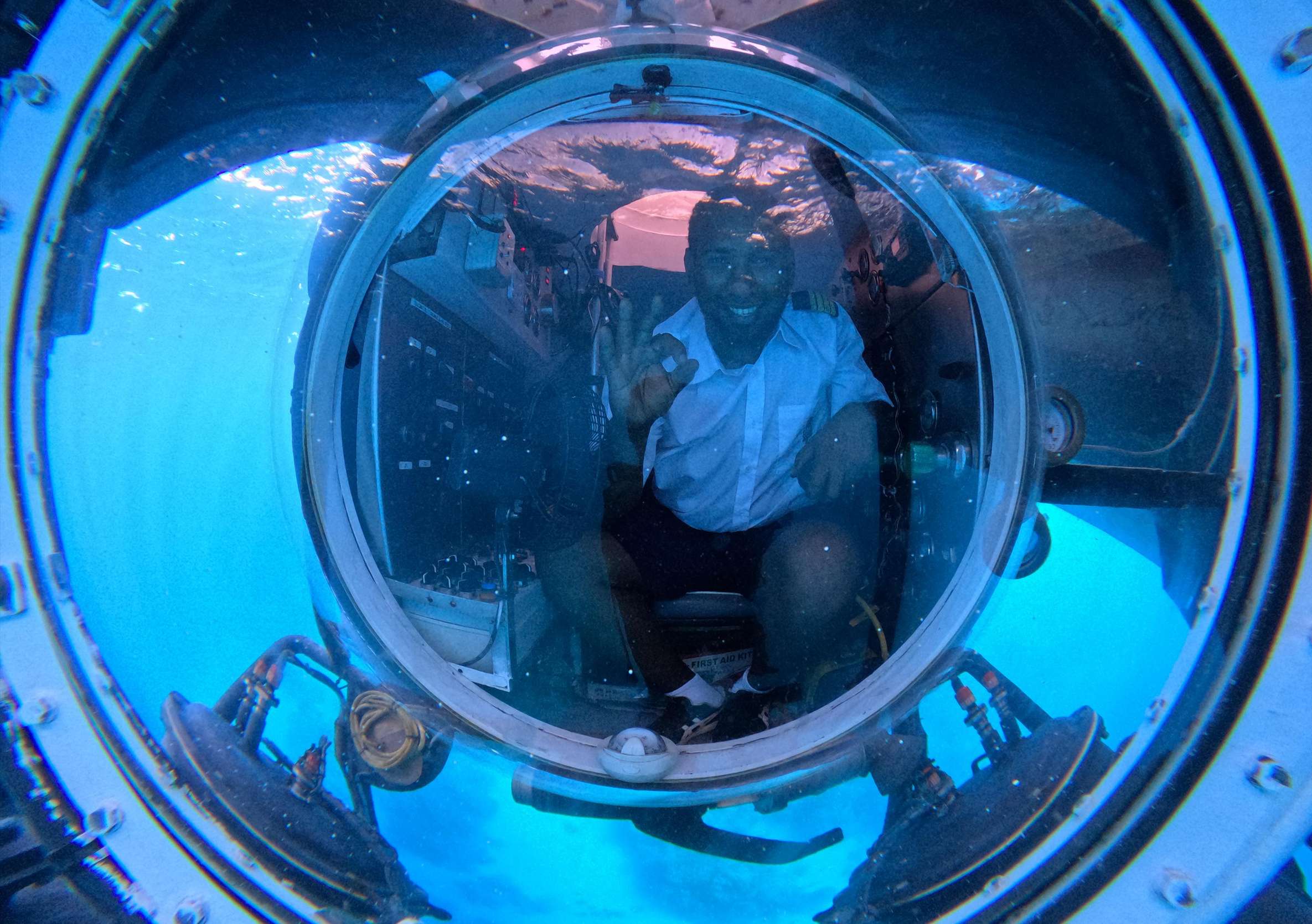
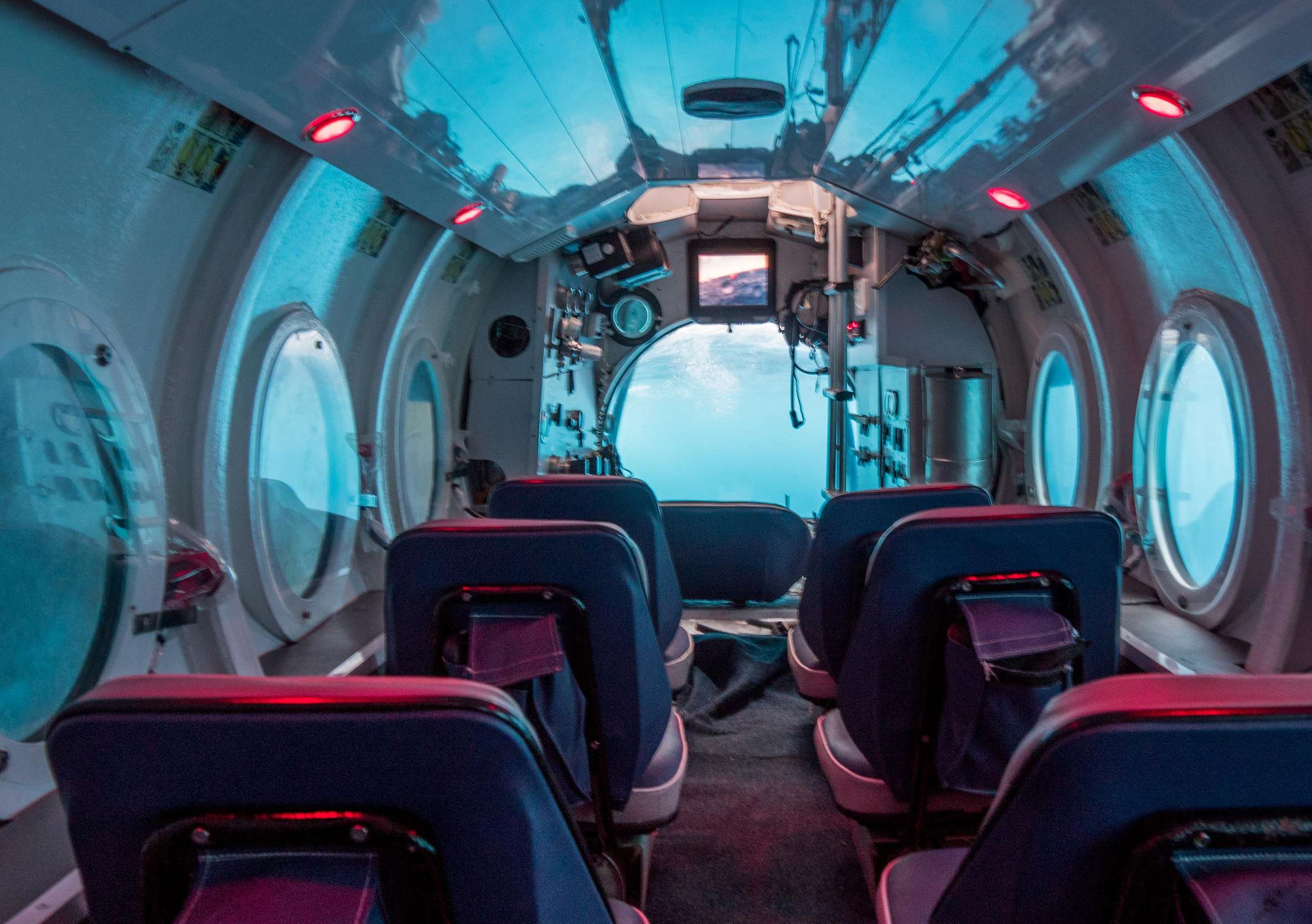
Down the ladder you go, into a 10-seat cabin where every seat has its own window. The hatch seals, and 40 minutes of descent and reef begin.
At 35 metres the light shifts. Red and yellow never make it this deep, so the wreck and the reef read in blues and greens.
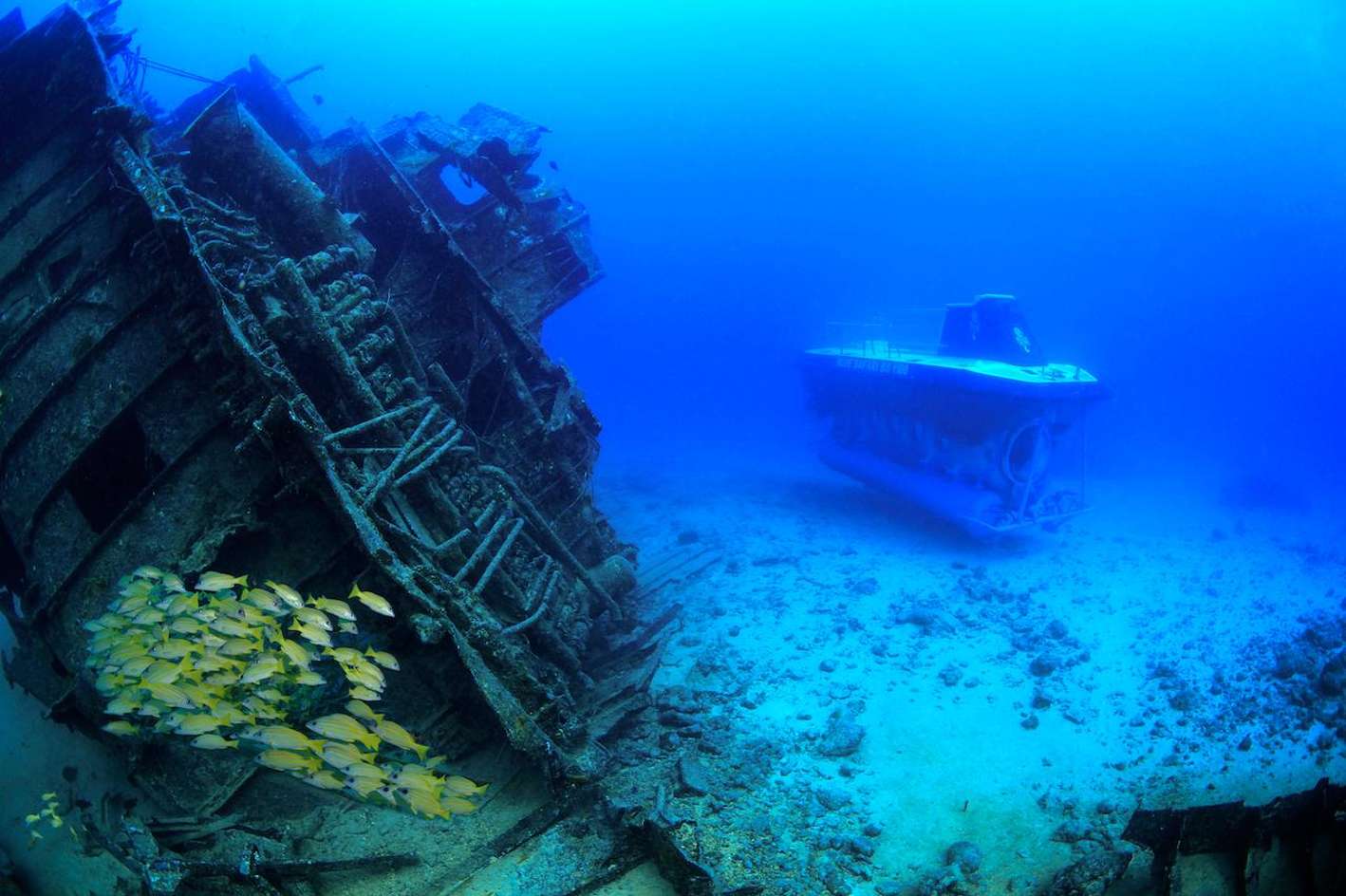
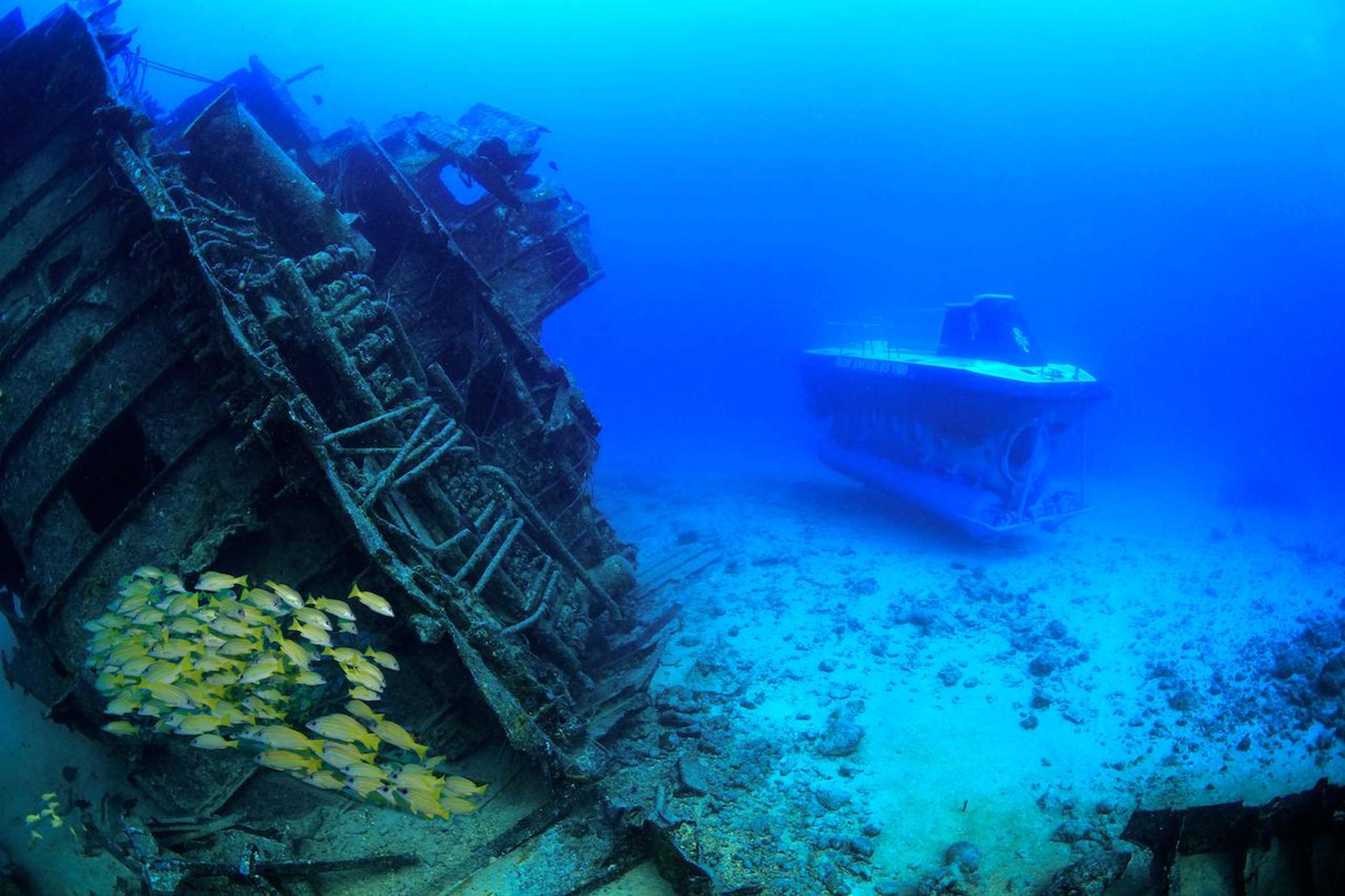
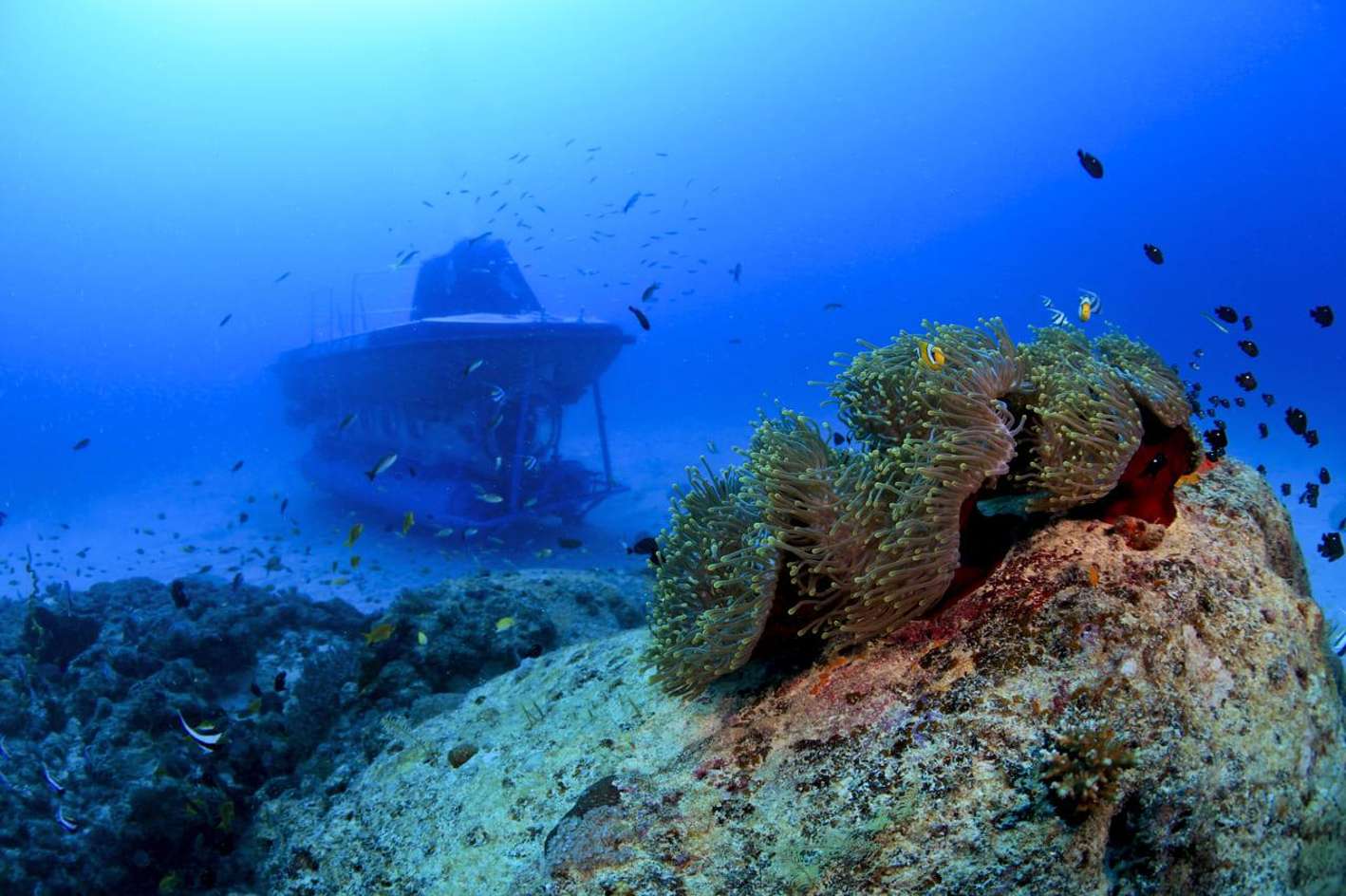
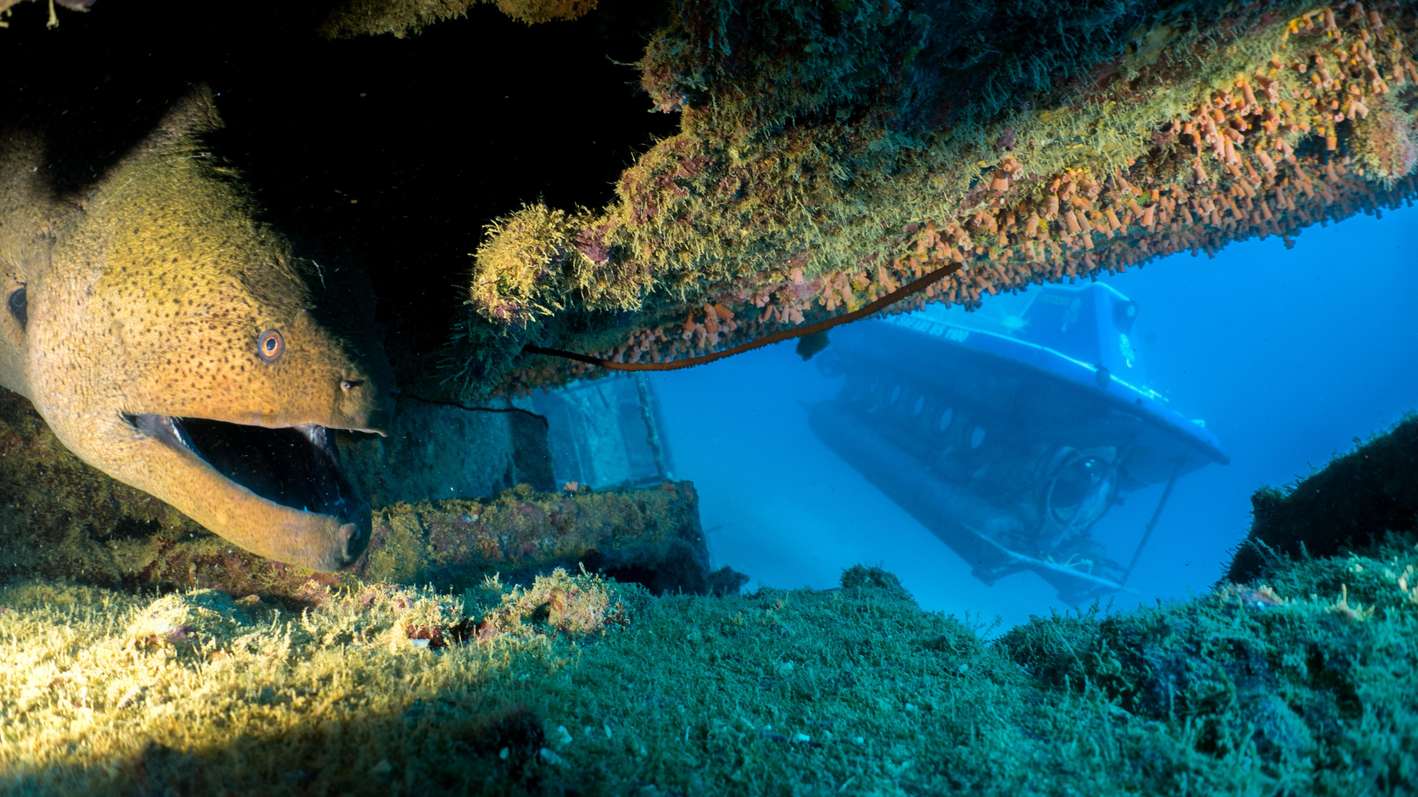
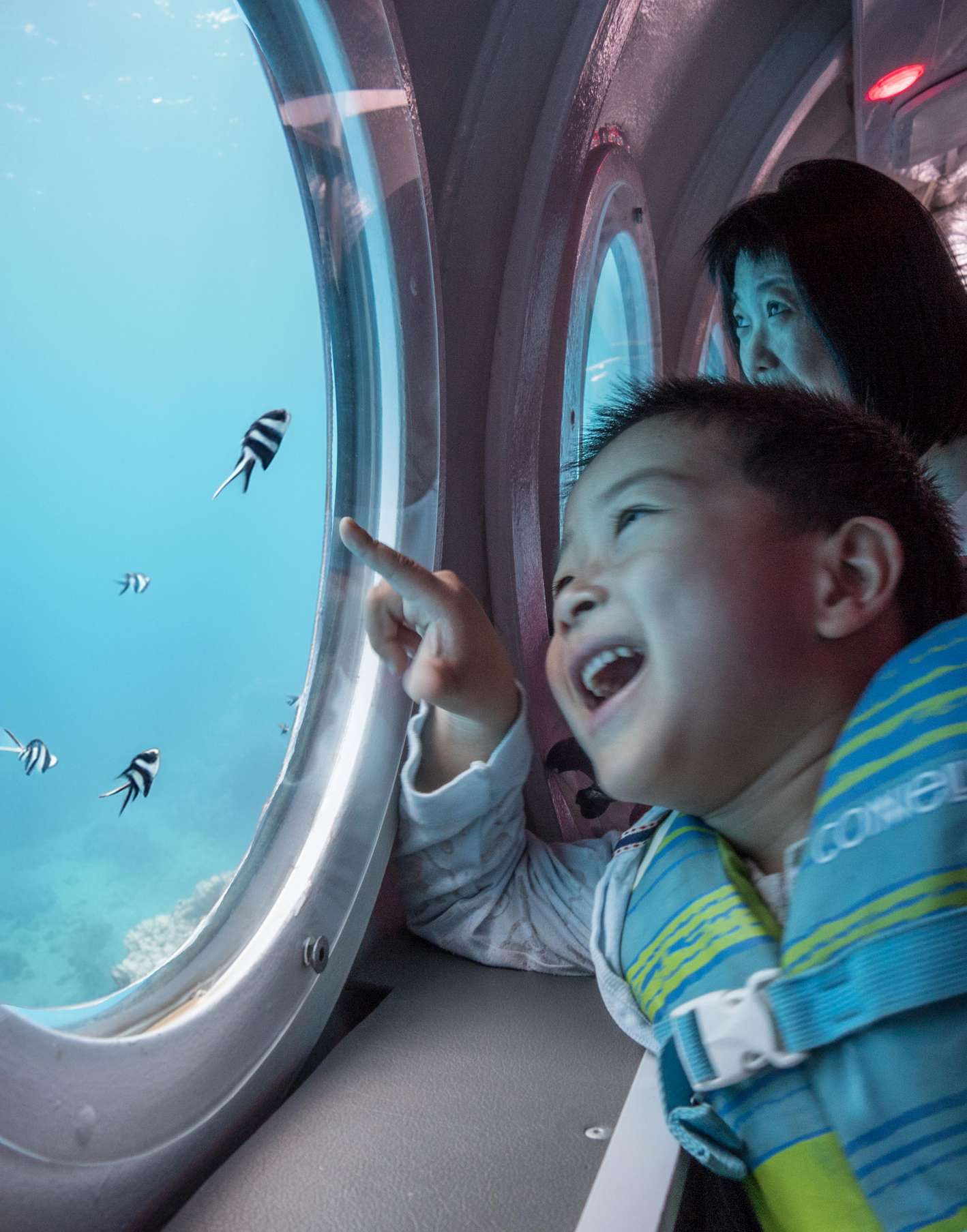
The Star Hope sits upright on the sand, schools of surgeonfish and capitaine threading its coral-covered superstructure, Javanese moray eels in the shadows, sea turtles passing. Beside the wreck lies a 17th-century sheet anchor.
Staff meet you on Coastal Road
This stretch can be choppy
Dry, air-conditioned and steady throughout
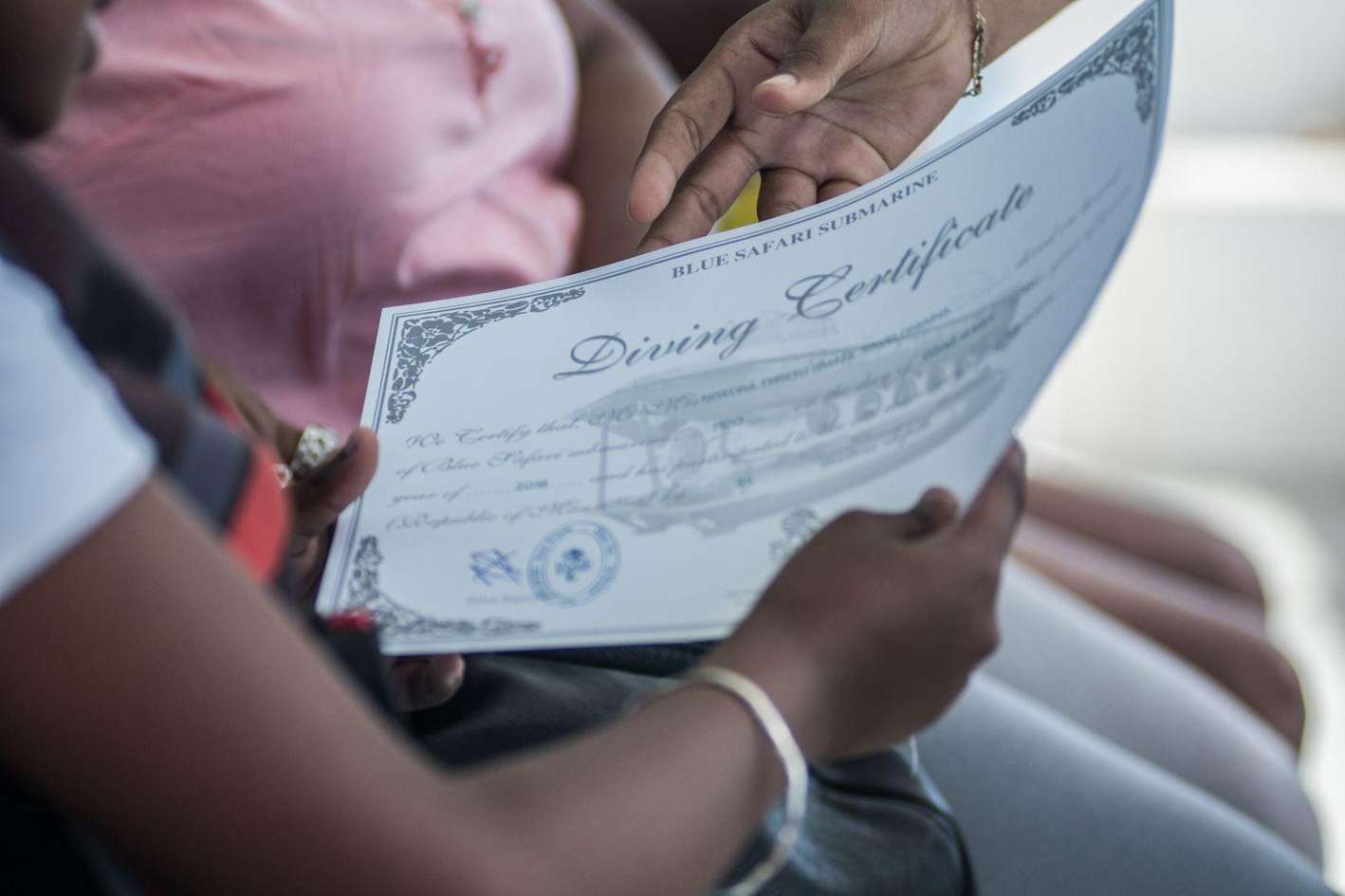
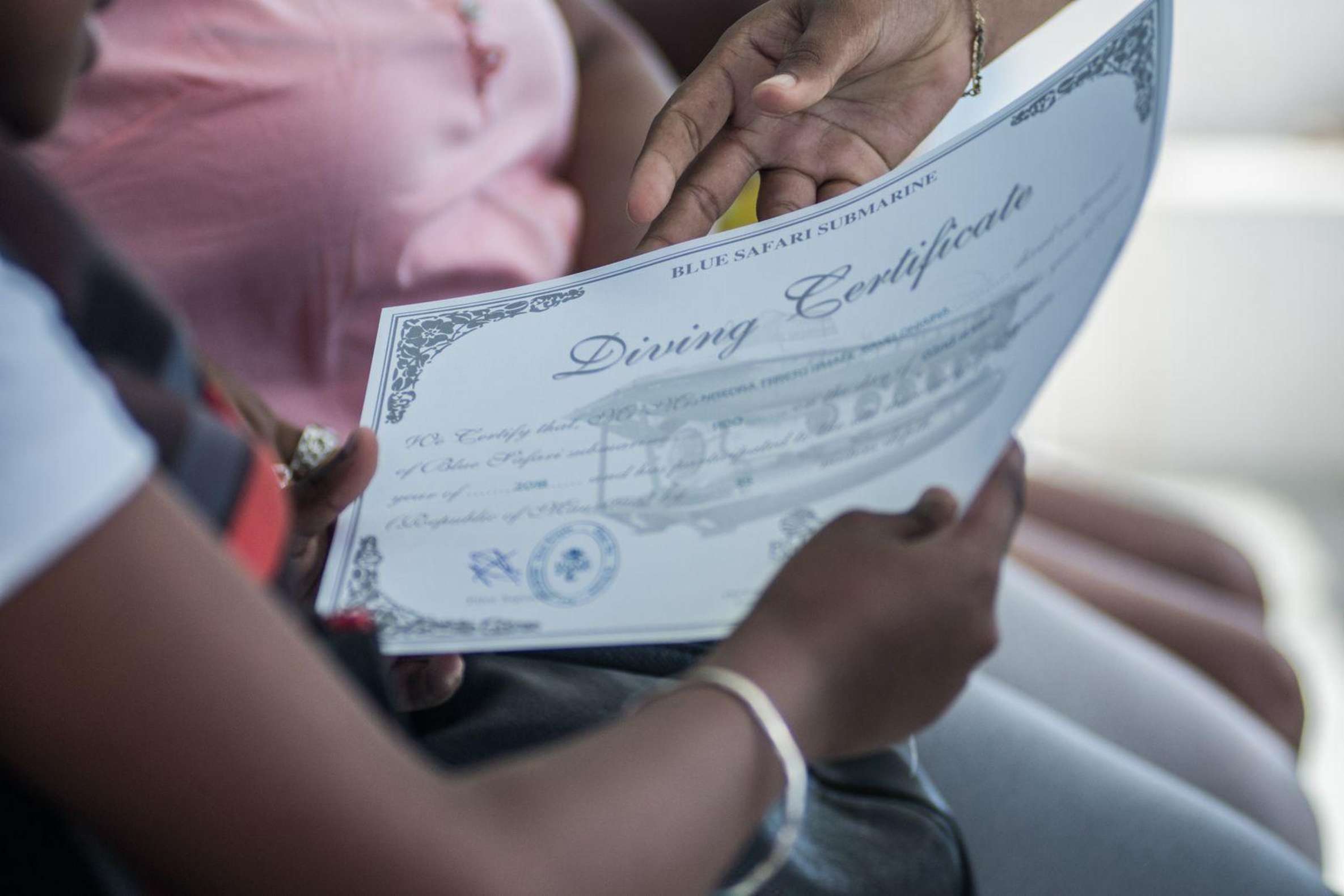
Refreshments and your dive certificate
Two reassurances for the nervous: the cabin holds normal surface pressure the whole way down, so your ears feel nothing, and once submerged the motion nearly stops, because the water down there is far calmer than the surface.
The shuttle ride is the part that can turn your stomach, and it lasts a quarter of an hour.
The tour this page leads with, the Trou-aux-Biches Submarine Tour to the Star Hope Wreck, runs this exact two hours and hands you a dive certificate and iced tea at the end.
Babies come aboard from 9 months old, and there is no upper age limit for seniors, so the extremes of the family are fine.
The test is in the middle: everyone climbs down a vertical ladder of 1.5 to 2 metres, unaided, after stepping between two boats. Anyone with restricted mobility will find that hard, and the tour lists mobility impairments as unsuitable.
Two hard limits sit at the hatch. The cabin cannot take anyone taller than 2 metres. Severe claustrophobia is a reason to pick a semi-submarine instead; a sealed hull at 35 metres tests the nerves of even willing passengers. Heart problems rule the dive out too.
Come in ordinary comfortable clothes, because you stay completely dry in the air-conditioned cabin. Flat shoes with grip are required for the boat transfers and the ladder; heels, long unslit dresses and saris are barred. Cameras are welcome; switch the flash off so it does not reflect on the portholes.
Boarding means a vertical ladder, unaided, in flat grippy shoes Heels and long unslit dresses are barred; wear sports shoes with grip and clothes you can move in. Anyone over 2 metres tall does not fit the cabin Check the tall teenager in your group before you book. Severe claustrophobia and heart problems rule the dive out Pick a semi-submarine with an open deck instead, or visit the oceanarium.
Work through those three lines with your own group before you book, and the hatch will hold no surprises on the day.
Transfers are not part of the standard tour, so the morning drive is on you. A private taxi, a rental car or a prearranged transfer are the only dependable ways to make a fixed departure time.
From Flic-en-Flac the drive runs about 56 minutes, from the east coast resorts about an hour, and from Le Morne in the southwest about 88 minutes over 67 kilometres.
Public buses exist and are cheap, but there is no direct route from the west or south. You change terminals in Port Louis, between Victoria Square and Immigration Square, and the trip stretches to well over two and a half hours each way. That math rarely works with a scheduled dive.
One way out of the driving: the Triolet Submarine Dive with Hotel Transfers picks you up from any hotel or villa across the island and includes the briefing, refreshments and certificate, which turns the whole logistics problem into someone else's.
Coming from the north coast, you are close anyway, and the water here is the clearest on the island.
Some days the sea says no. On a cyclone-warning day, or with a stroller and a grandparent in tow, the indoor answer sits in Port Louis: the Odysseo Oceanarium at Les Salines on the Harbour Waterfront, reached by a pedestrian bridge from the Caudan Waterfront.
Inside are about 200 species and 3,500 specimens across 45 aquariums, all native to the Indian Ocean. Themed zones run from the Lagoon and Coral Reefs to the Open Sea and a Sub-Oceanic View.
Sand tiger sharks and zebra sharks cruise the big tanks, jellyfish, seahorses, octopuses and lobsters fill the invertebrate halls, and there are no marine mammals. Several species here, parrotfish and rays among them, are the same ones you would meet in the lagoon.
Access is the headline: barrier-free paths, stroller-friendly throughout, baby-changing rooms and no minimum age. Audio guides let everyone move at their own pace. On the wrong weather day it is the best seat on the island.
From either coast the drive is under 40 minutes, which makes the oceanarium an easy half-day from almost any resort base.
There is a middle craft between the glass-bottom boat and the pressure hull, and for many families it is the right one.
A semi-submarine keeps its upper deck in the open air while an air-conditioned cabin sits 1.5 metres below the surface, with large side windows and a window for each of its 30 to 34 guests. Boarding means walking down steps instead of a vertical ladder, and the motion is gentler because nothing descends.
The real difference is psychological. Anyone uneasy in a sealed hull can step up to the open deck at any moment, something a true submarine can never offer. Toilets, showers and shade come as standard on the bigger semi-submersibles.
Know the geography before you plan a day around one: these boats have no scheduled departures from the southern or eastern coasts; they run from the island's north. And go early.
The sea is flattest between six and nine in the morning, before the sea breeze builds and chops up the surface from early afternoon. Operators schedule their first departures around eight to catch exactly that window.
Anyone who feels closed in simply walks upstairs, which no true submarine can allow.
You see the reef side-on through big windows, a wider angle than a glass-bottom boat gives.
Trade winds pick up from around 10 am and peak between 1 and 4 pm.
If a sealed hull worries anyone in your group, book the semi-sub without apology; the reef looks nearly the same through those windows.
Off Le Morne at the island's southwestern tip, sand and silt pour down the slope of an ocean trench and, from the air, look exactly like a waterfall. That is the whole trick.
It is an optical illusion of shifting sandbars, and from sea level or from underwater you cannot see it at all. Only a seaplane or helicopter flight renders it.
Two rules attach to that famous channel. Recreational drones may not fly over beaches or any public area in Mauritius, so launching one from Le Morne beach to film it is off the table; drone flying is restricted to private land with the owner's permission.
And stay out of the channel entirely: heavy swells breaking over the reef there drive fatal outflowing rip currents, so swimming, boating and kayaking over it are all dangerous.
The geology behind the island itself is calm. Mauritius sits on stable oceanic crust far from any plate boundary, its old volcano long dead because the mantle hotspot that built it drifted southwest to Réunion.
Damaging shaking has under a 2 percent chance in the next 50 years. The island is not sinking, and it is not going anywhere.
Timing decides how much you see down there. Visibility across the reefs runs from 10 to 40 metres, pushed around by rain runoff and trade winds.
Summer, from November to April, brings the warmest water at 26 to 29 degrees and the calmest seas; from May to October the water cools a little and steady southeast trade winds rough up the east and south coasts, while the sheltered north keeps diving through it.
The one wrinkle in summer is rain. Cyclonic rainfall from January to March washes sediment into the inshore lagoons and temporarily clouds them, though the outer reefs and northern offshore waters stay clear.
January: 5 out of 5 for water temperature. 28°C
Tap a month to read it.
January: 207 mm of rain. Warm 28°C seas provide strong visibility, though cyclonic downpours occasionally flush sediment into inshore lagoons.
Tap a month to read it.
May: 2.6 windy days. Drier winter weather sets in with 27°C water, while strengthening trade winds favor sheltered western dive sites.
Tap a month to read it.
December: calm sea on 87% of days. Warm 27°C seas and light winds provide excellent underwater visibility ahead of peak cyclone season.
Tap a month to read it.
August: waves up to 1.6 m on an average day. Water reaches its coolest at 24°C alongside steady trade winds, with minimal rain keeping leeward reefs clear.
Tap a month to read it.
December stands out with calm water on 87 percent of days, which is why the weeks around it fill up first.
But the dive site itself is forgiving all year: the west coast location runs in rain and even in easterly winds up to 70 or 80 km/h, and only heavy swells from the south through northwest stop the dives.
If that happens, the booking protects you: the operator reschedules the dive for another day or refunds you in full. Regulars book the submarine for the first day of their stay, leaving room to move it.
The submarine anchors the week; the rest of the water fills in around it. In Grand Baie you can walk the sea floor in a helmet, fed air from the surface and completely dry, no certification needed, usually twenty to thirty minutes on the sand after a speedboat run to a pontoon.
Non-swimmers do it happily. Book the helmet walk from Grand Baie; at one east-coast base travelers report short ten-minute sessions over thin sea life.
Subscooters sit you one behind the other under a transparent dome, breathing normally at about 3 metres for roughly 35 minutes. Catamaran days to Île aux Cerfs bundle snorkeling stops, dolphin watching and a beach barbecue into six or seven hours.
For a first scuba dive, the coral gardens of Blue Bay Marine Park in the south sit in calm, shallow water. Snorkelers do best in the protected reserves at Blue Bay and Pointe aux Piments.
And over Le Morne, a scenic flight reads the sand illusion from above, with children under two flying free on many routes.
The law underwater here is strict, and it protects the thing you came to see. Touching, chasing or holding onto marine turtles or cetaceans is prohibited in Mauritian waters.
Swimming with sperm whales commercially is strictly illegal, so walk past any boat tour that advertises it. Coral is protected too: cutting, removing or damaging it needs authorization, and buying or possessing native coral, dead or alive, is prohibited without a permit.
The wading hazards are quieter but real. Stonefish lie camouflaged on sandy bottoms, lionfish lurk in shallow reef water, and sea urchins carry long brittle spines.
The habit that covers all of them is simple: wear thick-soled water shoes entering from the shore, keep your hands out of reef crevices, and never turn over rocks, because a stonefish looks like one.
For swimming itself, the east and west coast beaches stay calm inside their barrier reefs, while the southern coast drops away quickly into deep water.
Anyone uneasy about open drop-offs does best in the sheltered lagoons and the enclosed dive site at Trou-aux-Biches, where the sea floor sits at a calm 18 metres with artificial reefs.
For seeing Mauritius's underwater life without a dive certification, the submarine has no rival on this island: 40 minutes at 35 metres, dry and pressurized, down at the Star Hope wreck where the fish actually concentrate.
Time it for early in your stay and early in the day, book the transfer-included version if you are far from the north coast, and it becomes the trip's best morning.
A semi-submarine stays on the surface with windows 1.5 metres down, a gentler pick for toddlers and less mobile relatives.
The famous waterfall off Le Morne is shifting sand seen best from the air; this page covers the helicopter and seaplane flights.
Visas, passport validity and entry forms for Mauritius, so nothing at the airport takes you by surprise.
The questions readers ask before they pick how to see what lives below the surface.
 Trou-aux-Biches2026
No. The island sits on stable oceanic crust, and earthquake hazard there is rated very low. The famous cascade off Le Morne looks like the island pouring into a trench, and the effect comes from sand and silt washing down an ocean slope, an optical illusion rather than a real drop.
More than 100 fish species, including butterflyfish, surgeonfish, parrotfish, clownfish and jackfish, appear in high numbers all year. Green and hawksbill sea turtles are present throughout the year, with sightings peaking between December and April. Stingrays show up almost every month, while whitetip reef sharks appear only occasionally.
No fully submerged restaurant operates in Mauritius. Marine-themed dining stays at surface level, in waterfront venues and floating restaurants.
Mauritius has overwater suites built above a natural lagoon, but no rooms below the waterline. Only about ten properties worldwide offered true underwater bedrooms as of October 2026, and none of them sit in Mauritius.
A passenger submarine takes you 35 meters down in a dry, air-conditioned cabin at normal pressure, so you stay in your own clothes and feel no ear changes.
Children from 9 months old are welcome, and non-swimmers ride without a problem. The Odysseo Oceanarium in Port Louis offers an indoor option on land, with about 200 species across 45 aquariums.
An aquarium keeps you on land, looking through glass tanks and walk-through tunnels at animals in tanks.
A submarine dive puts you 35 meters down in the open sea, where turtles, schools of surgeonfish and the Star Hope shipwreck drift past real reefs. The dive lasts 40 to 45 minutes inside an excursion of roughly two hours.
Stonefish camouflage themselves on sandy bottoms, lionfish hover near reefs with venomous spines, and long-spined sea urchins sit in reef-flat pools. Thick-soled water shoes cut the risk of a painful sting, and you should never touch a stonefish or lionfish, alive or dead, or turn over rocks.
No. Crocodiles are not native to the island and none roam free. The more than 2,000 Nile crocodiles you may hear about live in secure enclosures at La Vanille Nature Park.
Passenger submarines diving to 35 meters reach the Star Hope shipwreck, which sits upright on a sandy seabed with a 17th-century sheet anchor nearby. Sea turtles and Javanese moray eels are frequently seen around the hull, and schools of reef fish swim through the coral-encrusted superstructure.
Sea conditions can cause the dive route to be adapted, and heavy swells from the south-southwest through north-northwest can cancel a departure. Rain and strong easterly winds rarely stop the dive, because the site off Trou-aux-Biches stays sheltered. One practical tip: schedule the dive early in your stay so a rescheduled day still fits.
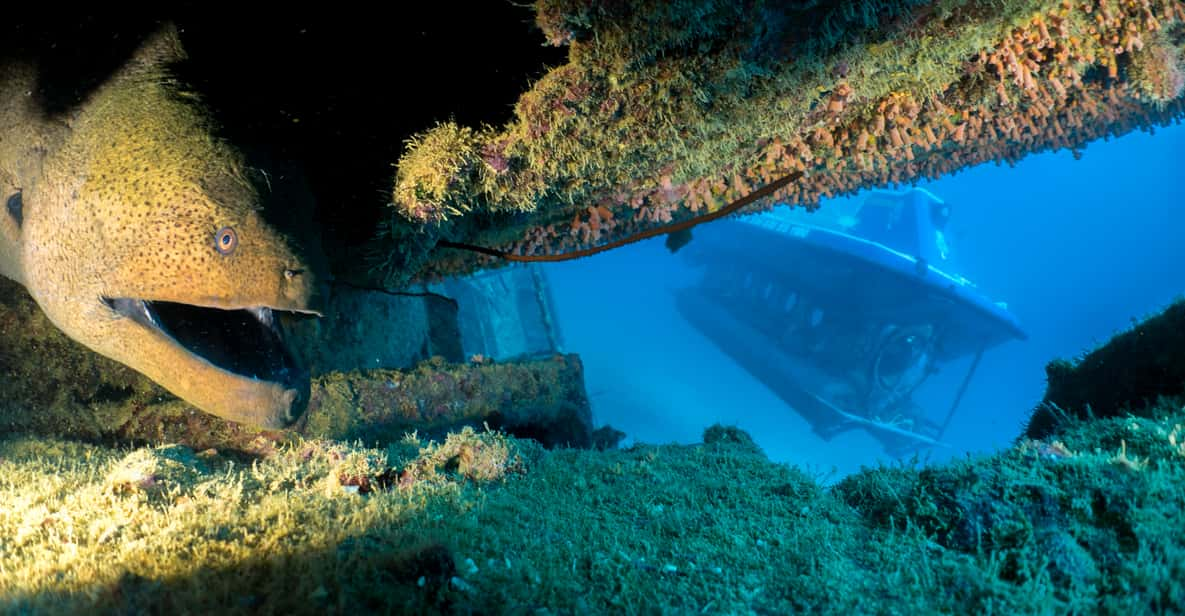
Dive 40 minutes down to the Star Hope wreck in a dry, air-conditioned cabin, and cancel free up to 24 hours before your tour.